 ultimate-guide
Used Truck Market Trends 2026: Prices & Outlook
Table of Contents
- Used Truck Market Trends 2026: What Buyers Should Expect
- Used Truck Prices and Pricing Trends in 2026
- Supply, Demand, and Used Inventory Levels
- Buyer Demand and Changing Fleet Preferences
- Regional Market Conditions and Vehicle-Class Differences
- Total Cost of Ownership, Financing, and Depreciation
- Your Used Truck Inspection Checklist
- Forecast Scenarios and What They Mean for Your Purchase
- Frequently Asked Questions
Last Updated: October 17, 2026
Used Truck Market Trends 2026: What Buyers Should Expect
The used truck market is settling into a new normal in 2026, and buyers who understand it avoid overpaying. At CDM Truck And Cycle Sales, we watch these shifts closely because they decide what shows up on our lot and what it costs. The headline for used truck market trends in 2026: prices are softer than the pandemic-era peak, supply is healthier, and buyers finally have room to negotiate. But "softer" doesn't mean cheap.
Used Truck Prices and Pricing Trends in 2026
Used truck prices in 2026 have largely stabilized after several volatile years, but unevenly. Asking prices hold firmer than transaction prices, so the sticker you see is often not the number that sells, that gap is your leverage. Mileage, age, and condition drive most of the spread, and clean, well-documented trucks still command a premium.
The useful question isn't whether prices are softer, it's how much a specific truck in a specific class should cost. Below are the pricing mechanics that separate a fair deal from an overpay.
Segment-by-Segment Price Benchmarks
Pricing varies sharply by segment, and lumping every truck together is a common mistake. Benchmark each truck against its own class, age band, and mileage band.
| Segment | Primary value drivers | What pushes price up | What pushes price down |
|---|---|---|---|
| Light-duty pickups | Condition, trim, mileage, accident history | One-owner, clean history, documented service, 4WD | High mileage, rebuilt title, fleet-white base trim |
| Medium-duty work trucks | Remaining service life, body/upfit, hours | Low hours, service body included, complete records | Corroded bed, missing upfit, gaps in maintenance |
| Heavy-duty tractors | Spec, engine/transmission, emissions vintage, miles | Pre-emissions or well-maintained emissions systems, APU, full records | High idle hours, deleted emissions, frame rust |
| Commercial fleet replacements | Remaining life, uniformity, records | Matched units, full dealer service history | Mixed specs, missing keys/records, cosmetic damage |
Three rules make these benchmarks usable. First, compare within a mileage band, a 150,000-mile pickup and a 400,000-mile tractor are not the same market. Second, adjust for age before cosmetics; a well-maintained older truck often beats a cosmetically clean newer one on value per remaining mile.
Why Asking Prices and Transaction Prices Diverge
The gap between asking and selling price is a signal, not an accident. Sellers list with room to negotiate, and that room grows the longer a truck sits, listings repriced after several weeks carry more room than fresh ones, because the seller has absorbed holding costs. Watch listing age, the number of price reductions, and whether the seller has re-listed the same truck. Those three signals tell you more about the realistic transaction price than the sticker does.
Depreciation and the Buy-Now-or-Wait Decision
Depreciation is steepest early and flattens with age, so a slightly older, well-maintained truck can offer better value than a nearly new one. In 2026, the steepest part of the curve has already been absorbed on late-model used units, so the discount for buying one model year older often exceeds the risk of additional wear. Before waiting for further softening, compare the expected price decline over your holding period against the cost of continuing to rent, lease, or repair your current truck.
Supply, Demand, and Used Inventory Levels
Inventory is the story behind the story in 2026. Used inventory has improved as more off-lease and fleet units return to the market, easing the shortages buyers remember and giving you more choice and bargaining power. Still, supply isn't uniform: certain heavy-duty configurations and clean work trucks remain scarce, keeping their prices firm. Days to sell is the metric to watch, when trucks move quickly, sellers hold firm; when turnover slows, discounts appear.
How New Truck Supply Affects Used Inventory
New truck supply is the quiet force shaping used inventory. When new-truck production improves, more buyers move to new, softening demand for late-model used trucks and pushing prices down; when new-truck supply tightens, buyers pivot to used and prices climb. Newer electric trucks and updated models can also make older units less desirable. Watch new-truck supply as an early signal for where used prices are heading.
Buyer Demand and Changing Fleet Preferences
Buyer demand remains steady, but preferences are shifting. Fleet buyers are stretching replacement cycles, changing what they sell into the used market and when. Individual buyers and contractors still want dependable work trucks and are paying more attention to operating costs than styling. Demand is now segmented by use case: a truck perfect for a contractor may be overkill for a family. Match the truck to the job, not the trend.
Regional Market Conditions and Vehicle-Class Differences
Regional market differences are real and matter more than most buyers expect. Regions with heavy construction and freight activity see stronger demand for heavy-duty and commercial trucks, while areas with more personal-use buyers lean toward pickups. Vehicle-class differences follow the same logic: work trucks sell on capability, pickups on condition and resale value. What sells fast in one market can sit in another, so focus on the trucks that actually move in your area rather than a national average.
Total Cost of Ownership, Financing, and Depreciation
The purchase price is only part of the equation. Total cost of ownership includes maintenance, operating costs, financing, and depreciation, which often outweigh the sticker difference between two trucks. Interest rates shape your monthly payment and total outlay, so scrutinize financing terms as closely as the vehicle. Plan your ownership horizon before you buy, and the math gets much clearer.
| Cost Factor | What It Covers | Why It Matters |
|---|---|---|
| Purchase price | Sticker and negotiated price | Starting point, not the full cost |
| Financing costs | Interest and terms | Small rate changes add up over the loan |
| Maintenance costs | Repairs and scheduled service | Condition and records predict this |
| Operating costs | Fuel and upkeep | Varies widely by truck and use |
| Depreciation | Value lost over time | Steepest early, flattens with age |
Your Used Truck Inspection Checklist
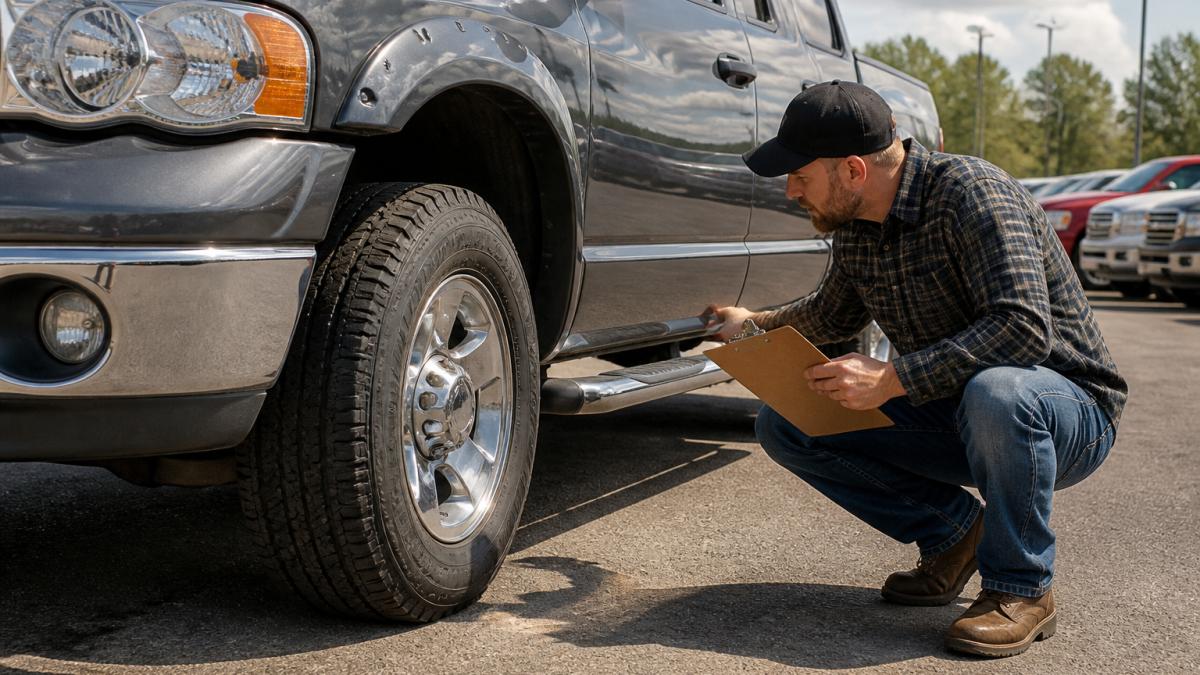
A used truck inspection checklist is your best defense against buying someone else's problem. Start with tires, brakes, and undercarriage, then check for fluid leaks, rust, and frame damage. Test every function: lights, gauges, four-wheel drive, and the hitch.
- Check tires for uneven wear and remaining tread
- Inspect brakes and rotors for scoring
- Look for fluid leaks under the engine and transmission
- Examine the frame and undercarriage for rust and damage
- Test all lights, gauges, and four-wheel drive
- Verify the hitch and towing hardware
- Start cold and listen for unusual engine sounds
- Take a highway test drive, loaded if possible
- Request an independent mechanical inspection
What to Verify in a Used Truck Vehicle History Report
A used truck vehicle history report is one of the cheapest safeguards you can buy. Verify title status first: a salvage or rebuilt title changes everything about value and insurance. Check for reported accidents, odometer consistency, and flood or lemon history, and confirm reported mileage matches the odometer. A clean report doesn't guarantee a perfect truck, but a dirty one tells you to walk away.
Reading Used Truck Maintenance Records
Used truck maintenance records tell you how the truck was actually treated. Look for regular oil changes, timely service, and documented repairs rather than gaps. A truck with complete records is easier to value and easier to resell. Missing records aren't automatically disqualifying, but they should lower your offer.
Forecast Scenarios and What They Mean for Your Purchase
Most 2026 outlooks give a single direction, softer, firmer, or flat, and leave you to guess which applies to your purchase.
| Scenario | What happens | Observable triggers | What it means for your purchase |
|---|---|---|---|
| Supply-led softening | New-truck availability keeps improving; late-model used units keep flowing back to market | Rising dealer inventories, longer days-to-sell, more off-lease and fleet returns | Favor buyers; negotiate hard on late-model used and don't rush |
| Freight-led tightening | Freight demand strengthens; work trucks and heavy-duty units tighten first | Falling days-to-sell on work trucks, rising auction prices for heavy-duty, stronger fleet utilization | Buy sooner if you need a work truck; expect less room on heavy-duty |
| Rate-driven cost squeeze | Interest rates rise; financing costs climb even if sticker prices hold | Higher quoted APRs, longer average loan terms, more buyer hesitation | Total cost of ownership rises; a cheaper truck financed well can beat a nicer truck financed poorly |
| Mixed / range-bound | Supply improves but demand stays steady; prices drift sideways | Stable days-to-sell, modest asking-to-transaction gaps, steady inventory | Buy the truck that fits your use case; price is unlikely to swing enough to justify waiting |
Three rules make these scenarios actionable. First, treat any forecast as possibilities, not a promise, the value is in the trigger, not the prediction. Second, watch days-to-sell and inventory in your own segment rather than a national headline; a tightening heavy-duty market and a softening pickup market can coexist.
What Would Change This Outlook
A few developments would invalidate the scenarios above and deserve a fresh look if they appear. A sharp change in new-truck production schedules would shift the supply path faster than inventory data shows. A sustained move in freight demand would tighten or loosen work-truck and heavy-duty pricing ahead of the broader market. Interest-rate changes would alter financing costs independently of sticker prices. And regulatory or tariff changes affecting new-truck costs can ripple into used values.
Frequently Asked Questions
Are used truck prices expected to go down in 2026?
Most forecasts point to stabilization rather than a sharp drop. New-truck production has recovered, which pushes more trade-ins into the used market and eases the tight inventory of recent years. Depreciation continues on a normal curve, so late-model trucks should soften gradually. Older, higher-mileage work trucks hold value better because budget buyers compete for them. Expect regional differences: areas with strong freight and construction activity keep firmer prices. Check current asking prices on specific trucks rather than waiting for a market-wide crash that forecasters do not predict.
What should I look for when buying a used truck in 2026?
Start with the service history and a vehicle history report, then inspect the truck in person. Check tire tread and uneven wear, rust on the frame and rocker panels, fluid condition, and whether the transmission shifts cleanly. For diesel models, ask about emissions-system service records. Verify mileage against the report, and have a mechanic do a pre-purchase inspection. Budget-conscious buyers should also confirm the truck's payload and towing ratings match the actual work it will do, not just the asking price.
What is a good mileage for a used truck?
There is no single number. A well-maintained truck with 120,000 miles and full service records can outlast a neglected one with 70,000 miles. As a rough guide, under 100,000 miles is comfortable for most buyers, 100,000 to 150,000 is normal for work trucks and demands a closer inspection, and above 150,000 miles you should expect wear items like suspension, brakes, and possibly transmission work. Condition, maintenance records, and how the truck was used matter more than the odometer alone.
How can I check a used truck's history before buying?
Request a vehicle history report using the VIN, and read it for title brands, accident records, odometer rollback flags, and registration gaps. Cross-check the reported mileage against the odometer and the maintenance records. Ask the seller for service invoices, and call the shop that did the work if the records look thin. A report is a starting point, not a guarantee, so pair it with a physical inspection by an independent mechanic before you commit.
The used truck market rewards buyers who do their homework, and it punishes those who don't. Whether you're hunting a dependable work truck or trading in your current one, CDM Truck And Cycle Sales makes the process simple, with a stress-free buying experience, a large network of industry connections to source specific vehicles, and fair offers on trade-ins even if you don't buy from us. Search our inventory and find the truck that fits your budget and your work.