 Listicle
Are Used Trucks Under $20,000 Good for Towing?
Last Updated: November 1, 2026
Quick Summary
The best used trucks for towing under 20k are often full-size pickups like the Ford F-150, Chevrolet Silverado 1500, and Toyota Tundra, chosen for their tow package and axle ratio. Towing under 20k depends on checking each truck's door-jamb sticker and payload, since maximum tow ratings can differ by thousands of pounds.
- Full-size pickups like the F-150 and Silverado 1500 are the usual starting point for budget towing.
- A factory tow package and the axle ratio strongly affect a truck's towing rating.
- Check the yellow payload sticker on the driver's door jamb for the exact truck's payload.
- Payload often limits half-ton trucks before the advertised maximum tow rating does.
- Get an independent inspection of the transmission, hitch, and cooling system before buying.
Table of Contents
- Which Used Trucks Under $20,000 Are Worth a Look for Towing
- Used Truck Towing Capacity by Year: What to Look For
- Half-Ton or Three-Quarter-Ton: Matching the Truck to Your Trailer
- Used Truck Pre-Purchase Inspection Checklist for Towing
- Choosing a Used Truck for Travel Trailers and Heavier Loads
- Ownership Costs and Fuel Economy While Towing
- Your Next Step: Budget, Inspection and a Test Drive at CDM Truck And Cycle Sales
- Frequently Asked Questions
Which Used Trucks Under $20,000 Are Worth a Look for Towing
Most budget towing shortlists for towing under 20k start with full-size pickups and older heavy-duty trucks.
Prices vary by mileage, trim, condition, and location, so treat any listing as a starting point rather than a guarantee. In our view, a model's name tells you less than its specific configuration does.
Full-Size Pickups: Ford F-150 and Chevrolet Silverado 1500
The Ford F-150 is a versatile choice for buyers who want one truck for work and towing. The catch is that the F-150's towing rating depends heavily on engine, axle ratio, and whether the truck has a factory tow package.
The Chevrolet Silverado 1500 appeals to buyers focused on towing with a V8 engine. Ask the seller which engine the truck has before you assume it can pull your trailer.
Heavy-Duty Options: Silverado 2500HD, Silverado 3500HD and Ram 3500
Heavy-duty trucks offer higher ratings for towing under 20k but often cost more to run. Older heavy-duty trucks can still be useful, but they often have more wear, higher fuel use, and larger repair bills.
If you pull a heavy trailer regularly, a heavy-duty truck may be the safer choice. If you tow occasionally, a well-kept full-size pickup often makes more sense.
Used Truck Towing Capacity by Year: What to Look For
Towing capacity is not a single number for a model name. It changes with model year, engine, cab style, drivetrain, axle ratio, and tow package. Two trucks that look identical on a lot can have ratings that differ by thousands of pounds. The table below shows commonly cited maximum ratings for certain configurations. Treat these as ceilings for the best-equipped version of that year, not as the rating of every truck you will find.
| Model year | Truck | Engine | Commonly cited max tow rating |
|---|---|---|---|
| 2015 | Ford F-150 | 3.5L EcoBoost V6 | About 12,200 lbs (requires Max Trailer Tow Package) |
| 2015 | Ford F-150 | 5.0L V8 | About 11,100 lbs |
| 2014 | Chevrolet Silverado 1500 | 5.3L V8 | About 11,200 lbs (with Max Trailering Package) |
| 2012 | Toyota Tundra | 5.7L V8 | About 10,400 lbs |
| 2015 | Toyota Tacoma | 4.0L V6 | About 6,500 lbs |
| 2014 | Chevrolet Silverado 2500HD | 6.0L V8 | About 13,000 lbs (conventional hitch) |
Why the Same Truck Has Different Ratings
Three variables do most of the work:
- Axle ratio. A numerically higher ratio (for example, 3.73 instead of 3.31) multiplies torque at the wheels and usually raises the tow rating. It also raises engine RPM on the highway and can cost a little fuel economy.
- Tow package. A factory tow package typically adds an auxiliary transmission cooler, an upgraded radiator, a hitch receiver, trailer wiring, and sometimes a integrated trailer brake controller. Without it, the rating drops.
- Cab, bed, and drivetrain. A crew-cab 4x4 weighs more than a regular-cab 4x2, and that extra weight comes straight out of payload and often out of tow rating.
How to Verify the Rating on the Specific Truck
- Door-jamb sticker. Find the Gross Vehicle Weight Rating (GVWR) and the front and rear Gross Axle Weight Ratings (GAWR). The sticker also lists the truck's curb weight on many models.
- Owner's manual or Ford/Chevrolet/Ram towing guide for that model year. These guides break ratings down by engine, axle ratio, cab, bed, and drivetrain.
- Payload sticker. On trucks built after 2009, a yellow payload sticker on the driver's door jamb states the payload for that exact vehicle as built. Payload is often the real limiter for travel-trailer buyers.
- VIN decode. A dealer or a VIN decoder can confirm engine, axle ratio, and tow-package content.
The Payload and Tongue-Weight Math Competitors Skip
Maximum tow rating gets the headlines, but payload is what sinks many half-ton setups. Here is the calculation most buyers never run:
- Payload capacity (from the yellow sticker): say 1,500 lbs on a well-equipped half-ton.
- Subtract passengers and cargo: two adults plus gear, roughly 400 lbs.
- Subtract the weight-distribution hitch: about 100 lbs.
A common pattern is that a half-ton rated to tow 11,000 lbs runs out of payload before it runs out of tow rating. Run the math on the specific truck before you fall in love with the trailer.
Budget Reality Check
Verify the axle ratio and tow package before you assume the rating.
Half-Ton or Three-Quarter-Ton: Matching the Truck to Your Trailer
A half-ton pickup suits lighter trailers, such as small boats, utility trailers, and compact campers. A three-quarter-ton truck handles heavier travel trailers and frequent hauling more comfortably. The difference is not just size, it is payload, braking, cooling, and frame strength. Here is how the two classes actually compare for a budget buyer.
| Half-ton (F-150, Silverado 1500, Ram 1500, Tundra) | Three-quarter-ton (Silverado 2500HD, Ram 2500, F-250) | |
|---|---|---|
| Typical payload | 1,500-2,000 lbs on well-equipped trims | 3,000-4,000 lbs |
| Typical max tow rating | 8,000-12,000 lbs depending on build | 13,000-17,000 lbs depending on build |
| Ride quality empty | Softer, more comfortable daily driver | Stiffer, heavier steering, worse fuel economy |
| Brakes and cooling | Adequate for occasional towing | Designed for sustained heavy loads |
| Under-$20,000 availability | Broad, many 2010-2016 examples | Narrower, mostly 2006-2014 with higher miles |
Match the Trailer Class to the Truck
- Travel trailers under about 5,000 lbs loaded (small couples' campers, teardrops, pop-ups): a properly equipped half-ton with a V8 or turbo V6 and a tow package is enough. A mid-size like a Tacoma can work for the lightest of these, but payload runs out quickly.
- Travel trailers of roughly 5,000-8,000 lbs loaded (bunkhouse models, larger couples' trailers): a half-ton is still viable, but only with a tow package, a weight-distribution hitch, and a payload number that supports the tongue weight. This is where most half-ton buyers get into trouble.
- Travel trailers over about 8,000 lbs loaded, or frequent towing in mountains: step up to a three-quarter-ton. The extra payload and braking margin matter more than the tow rating on paper.
The Tongue-Weight Rule and Why It Matters
Most experienced towers aim for a tongue weight near 10 to 15 percent of the loaded trailer weight, which keeps the trailer stable behind the truck. A 7,000-lb loaded trailer at 12 percent puts about 840 lbs on the hitch. Add a 100-lb weight-distribution hitch and 400 lbs of passengers and gear, and you have used roughly 1,340 lbs of payload before anything goes in the bed.
Under-$20,000 Trim Guidance
- Ford F-150 (2011-2014, 5.0L V8 or 3.5L EcoBoost): look for XLT or Lariat trims with the tow package and a 3.55 or 3.73 axle. Avoid trucks with the 3.31 axle if you plan to tow near the rating.
- Chevrolet Silverado 1500 (2010-2013, 5.3L V8): the Max Trailering Package (often on LTZ or higher trims) is the one to find. Verify the axle ratio, 3.42 is common, 3.73 is better for towing.
- Ram 1500 (2011-2014, 5.7L Hemi): the Hemi with the 3.92 axle and tow package is the strong towing build. Air suspension is comfortable but adds repair risk on a used truck.
A Note on Diesels Under $20,000
Older diesel three-quarter-ton and one-ton trucks can fit the budget, but they carry risks that gas trucks do not: expensive injector and fuel-system repairs, emissions hardware on 2007-and-newer trucks, and a history of heavy towing that is hard to verify. For occasional towing, a gas three-quarter-ton is usually the safer budget buy. For frequent heavy towing, a well-documented diesel can still make sense, but budget for repairs.
Quick Decision Rule
If your loaded trailer is under about 6,000 lbs and you tow a few times a year, a half-ton with a tow package is the practical choice. If it is over about 8,000 lbs, or you tow long distances in hills, a three-quarter-ton is worth the rougher ride and higher fuel cost. Between those numbers, run the payload math on the specific truck, that is where the decision is actually made.
Used Truck Pre-Purchase Inspection Checklist for Towing
A used truck that has pulled heavy loads may have wear that does not show on a quick walk-around. For a broader approach to thorough vehicle inspection, see how to inspect a used motorcycle and apply the same method. Use this checklist before you agree to a price:
- Review the maintenance history, especially transmission and cooling system service.
- Check the transmission fluid color and smell, and watch for slipping or harsh shifts on a test drive.
- Inspect the hitch, receiver, and frame for cracks, rust, or previous repairs.
Watch out: a truck with a worn hitch or a transmission that has been overheated can look fine on a short drive. Pay for an independent inspection before you buy.
Choosing a Used Truck for Travel Trailers and Heavier Loads
Travel trailers put more demands on a truck than most buyers expect. The trailer's weight, wind resistance, and braking all affect how the truck performs.
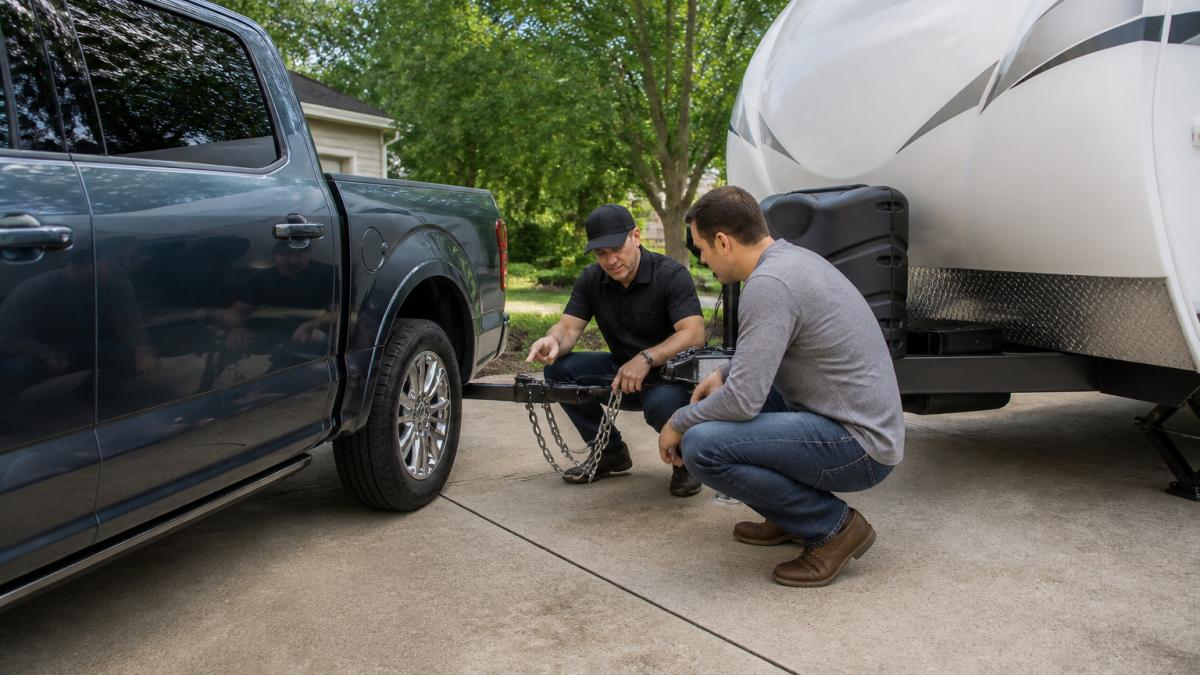
Ask whether the truck has been used to pull trailers before. Look for worn hitch marks or aftermarket brake controllers, which can signal past towing use.
Most buyers do better with a truck that has been maintained for towing than one with a higher rating but poor history.
Ownership Costs and Fuel Economy While Towing
Towing reduces fuel economy significantly, often by a large margin compared with normal driving. Plan your budget with that in mind, especially for longer trips.
Factor in insurance, registration, and possible repairs when comparing trucks. A lower purchase price can be offset quickly if the truck needs a new transmission or suspension work. We recommend setting aside a repair fund before you buy.
Your Next Step: Budget, Inspection and a Test Drive at CDM Truck And Cycle Sales
Set a realistic budget that includes taxes, fees, and a repair reserve. Then narrow your list to trucks whose towing ratings match your trailer with room to spare. Visit our showroom in Clute to see the inventory in person and take a test drive. Search All Vehicles to start your search, or review our buyer's guide for pre-owned trucks in Clute before you visit.
Frequently Asked Questions
What is the best used truck for towing under $20,000?
Among the used trucks named in recent under-$20,000 towing shortlists, the Ford F-150 and Chevrolet Silverado 1500 are the most frequently recommended full-size options, with the F-150 and Silverado both commonly cited as towing options. The best choice depends on the specific model year, engine, and condition of the individual truck. Before buying, confirm the maximum towing rating for that exact configuration in the owner's manual or door-jamb sticker, then compare it against your trailer's loaded weight. Pricing varies by mileage and condition, so verify each listing directly rather than relying on a general estimate.
How much can a used truck under $20,000 tow?
Towing capacity depends on the model year, engine, axle ratio, and whether the truck has a factory tow package, so there is no single number that applies to every truck in this price range. Heavy-duty options such as the Silverado 2500HD and 3500HD are built for larger loads than most half-ton pickups. For any used truck, find the rated capacity for the specific configuration, then subtract the weight of passengers and cargo from the payload rating to see how much tongue weight you can safely carry. A trailer should never exceed the rated maximum for that truck.
Should I buy a half-ton or three-quarter-ton truck for towing?
A half-ton pickup such as a Ford F-150 or Ram 1500 handles most travel trailers and boats comfortably and is easier to find, insure, and maintain on a budget. A three-quarter-ton truck, such as a Silverado 2500HD, is the better choice for heavier trailers, frequent long-distance towing, or contractor work with heavy loads. Heavy-duty trucks usually cost more to fuel and maintain, so match the truck to the heaviest trailer you realistically plan to tow rather than buying more capacity than you need.
What should I check before buying a used truck for towing?
Start with a pre-purchase inspection by an independent mechanic, focusing on the frame, hitch mounting points, transmission fluid condition, cooling system, and brakes, since towing puts extra stress on all of these. Ask for maintenance records and confirm whether the truck was previously used to tow heavy loads. Check the tow package, axle ratio, and engine on the door sticker or VIN, because these determine real towing capacity. Test drive the truck with a loaded or simulated load if possible, and listen for transmission hesitation or unusual noise under acceleration.
How do I know if a used truck can safely tow my trailer?
Compare your trailer's loaded weight, including cargo, water, and fuel, against the truck's maximum towing rating for its exact configuration. Then confirm the tongue weight, which is typically 10 to 15 percent of the trailer's loaded weight, falls within the truck's payload capacity after passengers and cargo are counted. Use a weight-distributing hitch if the trailer is heavy relative to the truck, and make sure the brake controller and trailer brakes meet the trailer's requirements. If the numbers are close to the limit, choose a larger truck.