 how-to
Buy a Pre-Owned Truck in Clute Texas: 2026 Buyer's Guide
Table of Contents
- Why Buy a Pre-Owned Truck in Clute, Texas
- How to Search Local Inventory and Compare Prices
- Financing a Used Vehicle With Bad Credit in Texas
- Used Truck Inspection Checklist Before You Buy
- How to Negotiate a Used Truck Price
- Truck Body Styles and Specs That Match Gulf Coast Needs
- Trade-In Value and Vehicle History Reports
- Frequently Asked Questions
Last Updated: September 25, 2026
Why Buy a Pre-Owned Truck in Clute, Texas
A pre-owned truck has already absorbed its steepest depreciation, delivering full-size capability for a fraction of a new-truck note. This guide from CDM Truck And Cycle Sales walks through how to buy a pre-owned truck in Clute Texas without the guesswork.
How to Search Local Inventory and Compare Prices
Start with a radius search, then filter hard. Most shoppers fail because they browse everything and compare nothing.
Using Search Filters to Narrow Your Listings
Filters are the difference between a 40-truck shortlist and a 400-truck wall of noise. Prioritize:
- Mileage: Under 100,000 miles keeps most modern trucks in their reliable middle years.
- Drivetrain: 4WD or AWD for Gulf Coast weather and job sites; 2WD if you only tow on pavement.
- Body style: Crew cab for families, extended cab for work crews, regular cab for pure utility.
- Transmission type: Automatic for daily driving, manual if you prefer control while towing.
- Fuel efficiency: Compare EPA ratings across the makes you're considering.
Financing a Used Vehicle With Bad Credit in Texas
Financing a used vehicle with bad credit in Texas is possible, but the terms depend heavily on your down payment and the lender's risk tolerance. Many buyers with damaged credit still get approved; they simply pay more in interest.
Down Payment and Monthly Payment Estimates
Pricing depends on the truck, the lender, and your credit profile, so no honest dealer quotes a payment before running your file. What you can control is the structure: aim for 10 to 20 percent down, keep the term short, and ask for the total cost of the loan, not just the monthly figure.
Used Truck Inspection Checklist Before You Buy
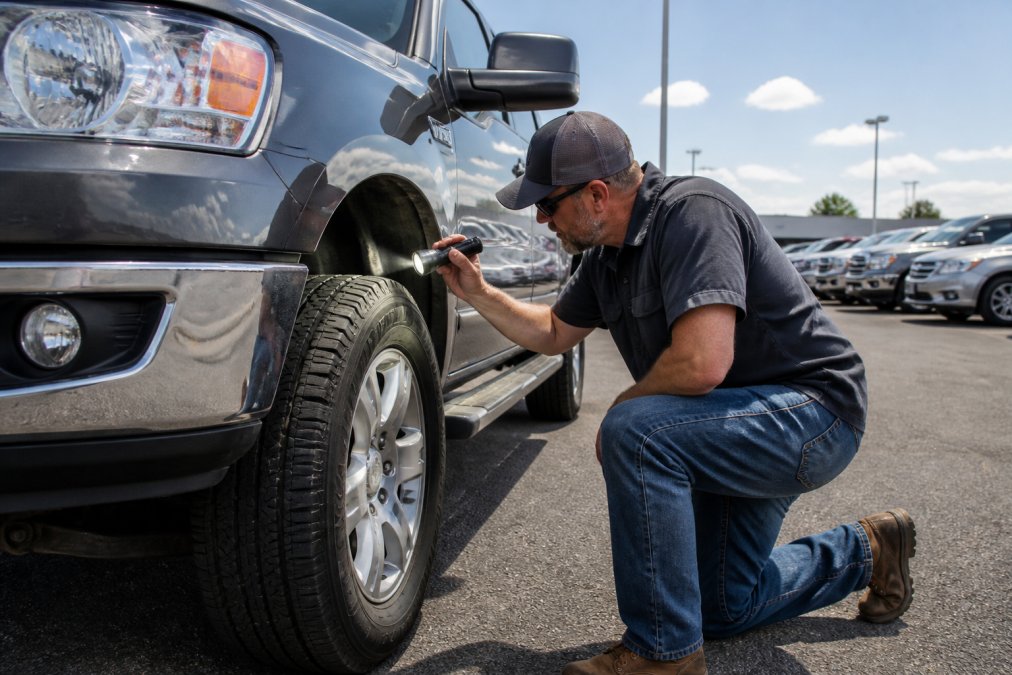
A pre-purchase inspection catches expensive problems before they become yours. On the Gulf Coast, that means checking two things most lists skip: salt-air corrosion and hidden flood damage. A truck that spent its life two blocks from the water can look clean on top and be rotting from the frame down.
The Coastal Rust and Flood Check
Rust is the number-one deal-killer on coastal trucks, and it hides in predictable places. Bring a flashlight and a magnet, and check these spots:
- Frame rails and crossmembers: Surface scale is normal; flaking, pitting, or metal you can push a screwdriver into is not. Pay attention to the area above the rear axle and behind the cab, where road spray collects.
- Rocker panels and cab corners: Tap along the bottom edge. A dull thud instead of a metallic ring means body filler over rust.
- Bed mounts and the bed floor: Pull up the bed mat if there is one. Standing water under a bed liner rusts the floor from the inside out.
- Brake and fuel lines: These are thin steel and often the first to fail on a salt-exposed truck. Run your hand along them and look for crusty, swollen, or wet spots.
- Tailgate and door seams: Water pools in the seams and works its way into the metal.
The Mechanical and Towing-Wear Check
A truck that towed heavy loads for a living wears differently than a commuter truck, and the odometer alone won't tell you which one you're looking at.
- Transmission: On a cold start, shift through the gears and feel for slipping, delayed engagement, or a hard clunk. The fluid should be reddish and smell clean, not brown and burnt. A transmission cooler and aftermarket hitch are clues the truck worked hard.
- Suspension and steering: Bounce each corner and listen for clunks. Uneven tire wear across the tread points to alignment or worn ball joints and tie rods.
- Cooling system: Towing stresses the radiator, water pump, and hoses. Look for coolant residue, a low reservoir, or a sweet smell that signals a leak.
- Brakes: Heavy towing eats pads and rotors. Check pad thickness and look for deep grooves or a pulsation through the pedal.
- Four-wheel-drive: Engage 4-High and 4-Low on a dirt or gravel surface and confirm it locks in and releases smoothly. A 4WD system that has not been used in years often seizes.
The Paperwork and Test-Drive Check
- Request the vehicle history report and confirm the mileage matches the odometer.
- Ask for maintenance records, a truck with documented oil and transmission service is worth more than one with none.
- Test every electrical feature: lights, windows, locks, A/C, and the infotainment system.
- Drive at highway speed and listen for driveline vibration, exhaust leaks, and wind noise.
- Take it to an independent mechanic of your choosing for a pre-purchase inspection.
If the seller won't allow an independent mechanic to inspect it, walk away.
How to Negotiate a Used Truck Price
Negotiation starts before you arrive, with research, not a lowball offer. Know the fair market value of the exact truck you want, then make your case with facts.
Truck Body Styles and Specs That Match Gulf Coast Needs
The right truck depends on how you'll actually use it, not on what looks best in the driveway. Buyers here juggle humidity, occasional flooding, boat ramps, and job-site hauling, so the decision comes down to three questions: how many people ride with you, what you tow, and where you drive. Answer those and the body style and drivetrain pick themselves.
Light-Duty vs. Heavy-Duty: Pick by Payload, Not by Looks
The most common mistake is buying more truck than the job requires, or less. Match the class to your real workload:
- Half-ton (light-duty): The default for most households. Handles a boat, a utility trailer, or a small camper, rides comfortably, and costs less to buy, insure, and fuel. If your towing stays under roughly 7,000 to 9,000 pounds and you tow a few times a month, this is usually the right call.
- Three-quarter-ton (heavy-duty): The step up when you tow heavy equipment, a large travel trailer, or a fifth-wheel regularly, or when you load the bed near its limit for work. Heavier frame, bigger brakes, and a stiffer ride that is the trade-off for the extra capability.
- One-ton (heavy-duty): For commercial hauling, gooseneck trailers, and the heaviest loads. Overkill for most personal use, and the ride and fuel cost reflect it.
Body Styles and What They're Good For
| Body Style | Best For | Typical Seating | Towing Focus |
|---|---|---|---|
| Regular cab | Pure work trucks, single drivers | 2-3 | Light to medium |
| Extended cab | Work crews needing extra storage | 4-5 | Medium |
| Crew cab | Families and full crews | 5-6 | Medium to heavy |
| Crew cab long bed | Heavy hauling plus passengers | 5-6 | Heavy |
A crew cab short bed is the most popular configuration for a reason: it carries the family during the week and still hauls on the weekend. The long bed costs turning radius and parking ease, so only step up if you regularly carry long or bulky loads.
Drivetrain and Terrain: 2WD vs. 4WD
Four-wheel drive earns its keep on wet boat ramps, unpaved job sites, and the occasional flooded road, and it holds resale value better here. Two-wheel drive saves on purchase price, fuel, and maintenance, and is perfectly capable if you stay on pavement and tow on dry days. If you launch a boat or work off-road even occasionally, 4WD is usually worth the premium.
Matching the Truck to the Job
- Plant and industrial commuter: A half-ton crew cab, 2WD or 4WD, with a comfortable ride and decent fuel economy. You rarely tow, so capability you never use is money wasted.
- Contractor or trades: A half-ton or three-quarter-ton extended or crew cab with a long bed, a tow package, and 4WD for job sites. Prioritize payload and a transmission cooler over luxury trim.
- Boat owner: A half-ton with 4WD and a properly rated hitch. Check the truck's towing capacity against the loaded weight of the boat, trailer, and gear, not just the dry weight.
- Family hauler that tows: A half-ton crew cab with the higher tow rating for its class. Confirm seating and towing both fit before you commit.
Trade-In Value and Vehicle History Reports
A vehicle history report documents a truck's past, title status, accidents, odometer readings, and service events. It is not a guarantee, but it flags the trucks you should avoid.
Frequently Asked Questions
What should I inspect before buying a pre-owned truck?
Check the frame for rust or cracks, look for fluid leaks under the engine and transmission, test all lights and electronics, and examine tire tread depth. Start the engine cold and listen for unusual noises. Request a vehicle history report to confirm mileage and accident records. A pre-purchase inspection by an independent mechanic costs far less than repairing hidden problems later. If a dealer refuses an inspection, walk away.
How do I finance a pre-owned truck with bad credit in Texas?
Start by checking your credit score and pulling your free credit reports to dispute any errors. Save for a larger down payment, which lowers the amount financed and improves approval odds. Credit unions and local dealerships that work with subprime lenders often approve buyers with scores below 600. Bring proof of income, proof of residence, and references. Expect a higher interest rate, so compare offers from at least three lenders before signing.
What are the benefits of buying from a local dealership versus a private seller?
A local dealership provides a physical location to inspect the truck, verified reviews from past customers. Private sellers may offer lower prices but leave you with no recourse if problems appear after the sale. Dealerships also handle title paperwork and trade-in processing in one visit. For buyers who want a stress-free experience, a local lot removes much of the risk.
How can I verify the vehicle history of a pre-owned truck?
Request a vehicle history report from the dealer or pull one yourself using the truck's 17-digit VIN. The report shows accident records, title branding (salvage, flood, lemon), odometer readings, and service history. Cross-check the report's mileage against the odometer and any service records. Texas floods make flood-branded titles a real concern along the Gulf Coast, so confirm the truck was never in a flood zone before you commit.