 How-to
How Much Can You Negotiate Off a Used Truck?
Last Updated: November 15, 2026
Quick Summary
To negotiate used truck prices well, research five to eight comparable local listings, adjust them for mileage and configuration, and set a target and walk-away number. Then inspect the truck, list the repairs it needs, and open with an offer backed by that evidence. Settle the truck price before discussing any trade-in.
- Pull five to eight local listings for the same year, make, model and trim.
- Adjust comparables for mileage, drivetrain, cab and bed setup, and condition.
- Record the repair costs you find during inspection and use them to justify a lower offer.
- Settle the truck's price first, in writing, before negotiating your trade-in.
- Ask dealers for an itemized out-the-door quote that shows all taxes and fees.
Table of Contents
- Step 1: Research the Truck's Market Value and Comparable Listings
- Step 2: Set Your Budget and Maximum Offer
- Step 3: Inspect the Truck and Build a Repair-Cost Checklist
- Step 4: Make an Opening Offer and Counter Effectively
- Negotiation Script and Worked Example for a Used Truck
- Your Next Step: Booking a Test Drive and Reviewing Inventory at CDM
- Frequently Asked Questions
Most buyers walk into a dealership expecting to haggle, but they rarely know how much room they actually have. The Federal Trade Commission and Consumer Financial Protection Bureau found that buyers pick a vehicle and negotiate its price, while the trade-in value is usually settled early in the same deal. The Auto Buyer Study: Lessons from In-Depth Consumer Interviews
Keep the two negotiations separate. Agree on the truck's price first, then talk about your trade-in. When you negotiate a used truck, dealers sometimes blend the two so the numbers look better than they are.
Step 1: Research the Truck's Market Value and Comparable Listings
Start by finding out what similar trucks actually sell for near you, not what one seller hopes to get. See current used truck pricing trends and outlook for how prices are moving this year.
Normalize the comparables before you trust them. A crew-cab four-wheel-drive diesel with 60,000 miles is not a fair comparison for a rear-wheel-drive gas work truck with 110,000 miles, even if both carry the same nameplate.
Truck-Specific Valuation Factors
Trucks are priced differently than cars because the configuration and the work history change what the vehicle is worth to the next buyer. Six factors matter most:
- Drivetrain and engine: Four-wheel drive and diesel engines usually command a premium, but that premium shrinks in regions where two-wheel-drive half-tons are the norm. Confirm the premium against local listings rather than assuming it.
- Cab and bed configuration: Crew cabs and longer beds add value in most markets, but a long bed with a single cab can sit unsold in a suburban market where buyers want passenger space. Match the configuration to local demand.
- Towing and payload ratings: Check the door-jamb sticker and the owner's manual for the actual tow and payload ratings, and confirm whether the truck has the factory tow package, integrated brake controller and hitch receiver. A truck rated to tow 12,000 pounds is worth more than an identically equipped truck rated to 7,000 pounds.
- Trim and options: Locking differentials, skid plates, bed liners, running boards and upgraded infotainment add value, but aftermarket lifts and oversized tires can reduce value if they suggest hard use or voided warranties.
- Mileage and commercial history: A truck used for heavy towing or fleet service wears differently than a personal-use truck. Ask for the vehicle history report and service records, and look for fleet registration, repeated brake and transmission service, or a fifth-wheel or gooseneck hitch as signals of commercial duty.
- Bed and body condition: Dents, rust, liner damage and tailgate wear are costly to fix and are legitimate grounds for a lower offer. Frame rust, especially near the rear axle and cab mounts, is the single most expensive finding on an older truck.
Write down a target range and a walk-away number based on your normalized comparables, not on the seller's asking price. That range is what you will use in Step 4 when you make an opening offer.
The factors below are the ones that most shift a used truck's value, so you can check each one against local listings before you make an offer.
| Factor | What to check | Effect on price |
|---|---|---|
| Drivetrain and engine | Four-wheel drive and diesel premium | Usually adds value, but less where two-wheel drive is the norm |
| Cab and bed configuration | Crew cab and longer bed | Adds value in most markets, depending on local demand |
| Towing and payload ratings | Door-jamb sticker, tow package, brake controller | Higher ratings are worth more |
| Trim and options | Locking differentials, skid plates, bed liners | Adds value |
| Aftermarket modifications | Lifts and oversized tires | Can reduce value |
| Commercial history | Fleet registration, heavy towing, fifth-wheel hitch | Signals harder wear |
| Body and frame condition | Dents, liner damage, frame rust | Costly to fix and grounds for a lower offer |
Step 2: Set Your Budget and Maximum Offer
Decide on your real budget before you visit. Include taxes, title and registration fees, and any add-ons the dealer offers. Many buyers focus only on the monthly payment and end up paying far more over time.
Write down a maximum offer and do not go above it, even if the salesperson pushes. Knowing your walk-away number keeps you calm and in control. If you are working with a tight budget, our pre-owned inventory guide can help you see which reliable trucks fit under a set price.
Step 3: Inspect the Truck and Build a Repair-Cost Checklist
A careful inspection gives you facts to justify a lower price. Bring a notepad and check the tires, brakes, fluids, frame, bed and undercarriage. Note anything that will need work soon.
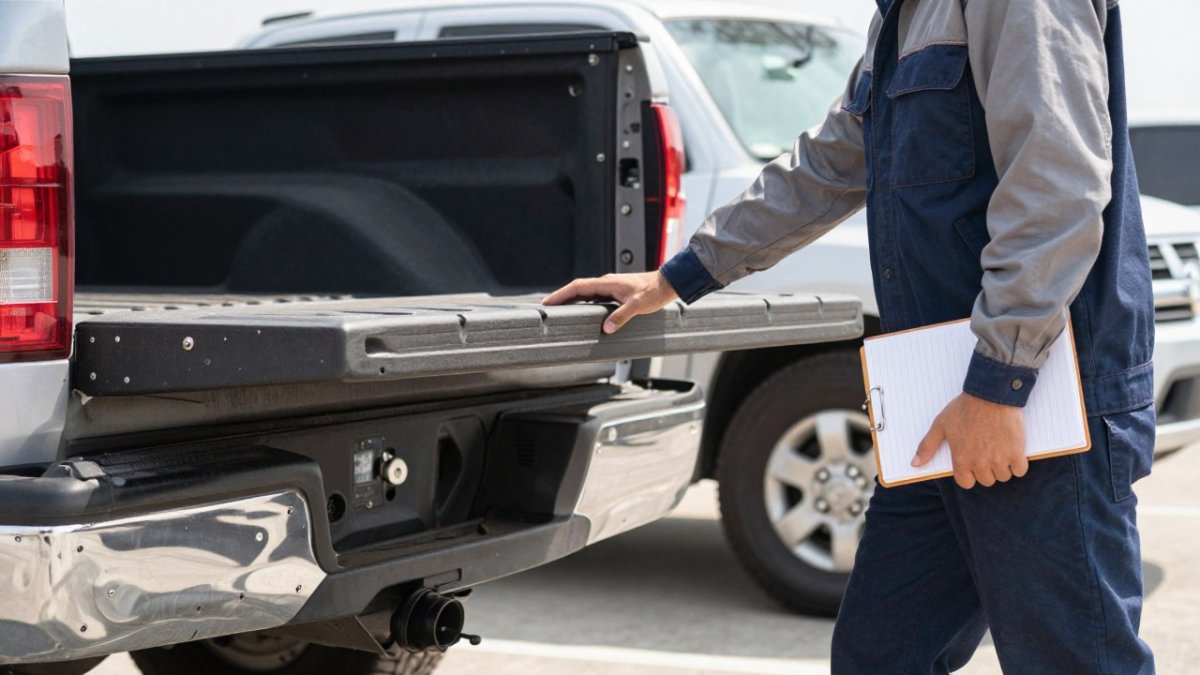
Watch out: a truck that looks clean can still hide frame rust or a worn transmission. Ask for a test drive on a route with hills and highway speeds.
Use this checklist to track what you find:
- Tire tread depth and matching brands
- Brake pad and rotor wear
- Fluid color and level (oil, coolant, transmission)
- Frame rust, especially near the rear axle
- Bed liner damage and dents
- Warning lights or unusual noises during the drive
- Estimated repair cost for each issue
Every item you find with a repair cost is a reason to ask for a lower price.
Reviewing Vehicle History and Maintenance Records
Ask for the vehicle history report and any service records. Look for regular oil changes, past accidents and whether the truck was used for towing or hauling heavy loads. A well-documented truck usually holds its value better in negotiation.
Step 4: Make an Opening Offer and Counter Effectively
Open below your target price, but not so low that the seller stops taking you seriously. Many buyers open below their target price, backed by the comparables and repair estimates you gathered in Steps 1 and 3.
Expect a counteroffer. Stay polite, restate your evidence, and be ready to walk away. Many buyers find that a willingness to leave is their strongest tool, especially on a truck that has been listed for several weeks.
Private-Party Versus Dealer Negotiation
The seller type changes your leverage, your paperwork and your risk, so adjust your approach accordingly.
- Private-party sellers usually have more room to move on price because they are not protecting a dealer's margin, but they also have less incentive to fix problems before the sale. Ask for service records, insist on a pre-purchase inspection at a shop you choose, and confirm the title is in the seller's name and free of liens. Private sales are typically as-is, so every defect you find is a direct price reduction.
- Dealers have more room to move on the total deal than on the advertised price. Ask for an out-the-door quote in writing that itemizes taxes, title and registration fees, documentation fees and any add-ons (Car Dealer Ads and Promotions: Know Before You Go). Dealer fees vary widely and are often negotiable. Dealers may also offer a limited warranty or return window, which has real value and is worth weighing against a lower private-party price.
- Remote negotiation works for both seller types. Ask for additional photos of the frame, bed, tires and odometer, request a video walkaround, and negotiate the price and the out-the-door total before you drive to the lot. A seller who will not provide photos or allow an inspection is telling you something.
Negotiation Scripts and a Worked Example
Here is a simple structure for a dealership conversation:
"I like this truck and I'm ready to buy today. Comparable 2019 models in the area are listed between $24,500 and $26,000. This one needs new front brakes and two tires, about $1,100 in repairs. My offer is $23,000 out the door, including fees."
For a private-party seller, the same evidence works with a different close:
"I've looked at similar trucks in the area. Yours needs front brakes and two tires, and there are no service records. I can make an offer today, pending a pre-purchase inspection."
Worked example: A truck is listed above the market average of comparable trucks, and it needs repairs and has no service records. A fair opening offer can be set below the asking price, then adjusted after counteroffers. Respond to a counter with the repair estimate and one comparable rather than a new number, and hold your walk-away figure.
Watch out: dealers sometimes blend the truck price and your trade-in into one monthly payment to obscure the real numbers. Settle the truck price first, in writing, then negotiate the trade-in separately.
Negotiation Script and Worked Example for a Used Truck
Here is a simple way to structure the conversation:
"I like this truck and I'm ready to buy today. Comparable 2019 models in the area are listed between $24,500 and $26,000. This one needs new front brakes and two tires, about $1,100 in repairs. My offer is $23,000 out the door, including fees."
Worked example: The truck is listed at $25,000. Comparable listings average $25,800, but the truck needs $1,100 in repairs and has no service records. A fair opening offer could be $22,900, leaving room to settle between $23,500 and $24,000 after counteroffers. Your final number depends on the market and the seller, so treat this as a method, not a guarantee.
Your Next Step: Booking a Test Drive and Reviewing Inventory at CDM
Now that you know how to research, inspect and negotiate, the next step is seeing trucks in person. At CDM Truck And Cycle Sales, we aim to make the process simple, from your first look at the truck to a clear, fair deal. We will also buy your trade-in even if you do not buy from us, and our industry network can help find a specific truck we do not have on the lot. For background on the local process, read our guide to buying a pre-owned truck in Clute, Texas.
Frequently Asked Questions
How much can you negotiate off a used truck?
The amount a buyer can negotiate off a used truck depends on how the listed price compares to comparable trucks, how long the vehicle has been on the lot, and what your inspection reveals. Start by comparing the asking price against similar trucks with similar mileage, condition and options. If the listing is above market value or the truck needs repairs, you have a documented basis for a lower offer. Set a maximum price before you negotiate and be prepared to walk away if the seller will not move close to it.
Can you negotiate the price of a used truck at a dealership?
Yes. Dealerships generally expect negotiation on used trucks, and the listed price is usually a starting point rather than a final figure. Focus on the out-the-door price, which includes fees and add-ons, rather than only the monthly payment. Ask for an itemized breakdown, question any dealer fees, and compare the total against your research. Negotiating the purchase price, your trade-in value and financing separately often produces a better overall result.
What should you say when negotiating a used truck price?
Keep the conversation polite, specific and based on evidence. For example, say you have researched comparable trucks and would like to make an offer based on the market value, then name your figure. When countering, point to concrete items such as needed repairs, tire wear or mileage differences. Avoid revealing your maximum budget, and be willing to say you need to think it over. A calm, firm tone and a readiness to walk away usually produce better results than aggressive tactics.
Does paying cash help you negotiate a better price on a used truck?
Paying cash or showing that you have financing already arranged can make your offer more credible and simplify the transaction for the seller, which may help when negotiating. However, the effect varies by dealer and market conditions. Cash does not replace research. Compare the total cost of any financing offered, since dealer-arranged loans can carry higher rates or added fees, and make sure any price reduction is reflected in the out-the-door figure.