 How-to
How to Finance a Used Motorcycle in Texas
Quick Summary
Yes, you can finance a used motorcycle through a dealer, a bank or credit union, or a personal loan. Each works differently, so compare the rate and total cost of each before you choose one.
- Get preapproved by a bank or credit union before you visit a dealer.
- Compare loan offers by APR and total cost, not just the monthly payment.
- A bigger down payment lowers your monthly payment and total interest.
- Lenders check your credit, income, down payment, and the bike's age, mileage, and title.
Table of Contents
- How to Finance a Used Motorcycle in Texas
- Can You Finance a Used Motorcycle and Who Offers the Loan
- Used Motorcycle Financing Requirements Lenders Check
- How Much Down Payment a Motorcycle Loan Requires
- Dealer Motorcycle Financing Versus a Bank or Credit Union Loan
- How to Compare Motorcycle Loan Offers by Total Cost
- Risks to Avoid: Long Terms, Negative Equity and Add-On Products
- Preparing Your Documents and Applying for Your Used Motorcycle Loan
- Frequently Asked Questions
How to Finance a Used Motorcycle in Texas
Last Updated: October 30, 2026
Can You Finance a Used Motorcycle and Who Offers the Loan
Yes, you can finance a used motorcycle. Most buyers use one of three sources: a dealer, a bank or credit union, or a personal loan. Each one works a little differently, and the right pick depends on your credit, your budget and how fast you want the money.
Navy Federal Credit Union lists used-motorcycle loan rates of 7.45% and 10.05% as of October 29, 2026 (Navy Federal Credit Union motorcycle loan rates). The listing does not say which rate a given borrower gets, so treat it as a starting point, not a quote.
Here is how each one generally works:
- Dealer financing: Applied for at the point of sale. It is convenient, but compare the rate to outside offers.
- Bank or credit union loan: Often has lower rates for members with good credit. You shop for the loan before you shop for the bike.
- Personal loan: Unsecured, so the bike is not the collateral. Rates can be higher, but it works for older or lower-value bikes that a lender may not want to secure.
Used Motorcycle Financing Requirements Lenders Check
Lenders look at a few core things before they approve a motorcycle loan. These are your credit history, your income and debts, and the bike itself.
- Credit score and history: A stronger score usually means a lower rate.
- Income: Lenders want proof you can make the monthly payment.
- Down payment: A larger down payment lowers the amount you borrow.
- The bike: The age, mileage, condition and title all matter.
How Age, Mileage, Condition and Title Status Affect Approval
Lenders care about the bike as much as you. An older bike with high mileage is harder to finance because it loses value fast and may not cover the loan if you default.
- Age and mileage: Many lenders set limits on how old or how high-mileage a bike can be.
- Condition: A clean, running bike is easier to approve than one that needs repairs.
- Title status: A clean title is required by most lenders. A salvage or rebuilt title often means no loan.
A common mistake is assuming a private-party bike qualifies just because you have good credit. Check the bike's age and title first.
Buying From a Private Seller: A Financing Checklist
Buying from a private seller takes more legwork than buying from a dealer. Before you apply, gather these items:
- The seller's name and the bike's VIN
- A clean title in the seller's name, with no liens listed
- A current registration and proof of insurance
- A bill of sale with the agreed price
- A recent inspection or mechanic's report
Not every lender will finance a private-party sale. Call ahead and ask before you find a bike you love.
How Much Down Payment a Motorcycle Loan Requires
There is no single down payment rule. Many lenders ask for a down payment of 10% to 20% of the purchase price, but requirements vary by lender, credit and bike.
A bigger down payment helps in three ways:
- You borrow less, so your monthly payment drops.
- You pay less interest over the life of the loan.
- You reduce the risk of owing more than the bike is worth.
Watch out: A small down payment on an older bike can leave you owing more than the bike is worth for years.
Dealer Motorcycle Financing Versus a Bank or Credit Union Loan
Dealer financing is often quick, which is why many buyers use it. A bank or credit union loan can cost less, but it may take more time.
Dealer financing
- Apply on the spot
- Can be convenient for buyers with mixed credit
- Rates may be higher than outside loans
Bank or credit union loan
- Often lower rates for good credit
- Requires shopping before you buy
- Gives you a preapproval to bargain with
Getting preapproved before you visit a dealer is one of the strongest moves you can make. It shows you the rate you qualify for and gives you a number to compare.
How to Compare Motorcycle Loan Offers by Total Cost
A low monthly payment can hide an expensive loan. Two offers with the same payment can differ by hundreds of dollars once you add up interest and fees, so compare offers by total cost, not by the advertised payment.
The numbers that actually decide the cost
Every motorcycle loan offer is built from five inputs. Get all five in writing before you compare:
- Amount financed: the bike price minus your down payment and any trade-in credit.
- APR: the annual percentage rate, which folds in the interest rate plus most lender fees. This is the number to compare, not the base interest rate.
- Term: the number of months you will make payments.
- Monthly payment: the amount due each month.
- Fees: origination, documentation, title, and lien fees. Ask whether each is already inside the APR or added on top.
A worked comparison
Say you are financing $6,000 after your down payment. Here is how two offers can look almost identical at the payment level but very different in total cost:
| Offer A | Offer B | |
|---|---|---|
| Amount financed | $6,000 | $6,000 |
| APR | 8.9% | 12.9% |
| Term | 36 months | 60 months |
| Monthly payment | about $190 | about $136 |
| Total of payments | about $6,840 | about $8,160 |
| Total interest | about $840 | about $2,160 |
Offer B feels easier because the payment is roughly $54 lower, but it costs about $1,320 more over the life of the loan. That is the trade-off a payment-only comparison hides.
Use this formula to check any offer yourself:
Total cost = (Monthly payment × number of months) + down payment + any fees paid upfront
Then subtract the bike's purchase price to see your total borrowing cost. The result is the real price of financing.
How to read an APR disclosure
When a lender gives you a Truth in Lending disclosure, the APR and the finance charge are the two lines that matter most. The finance charge is the dollar amount of interest and fees you will pay over the term. If a dealer quotes a payment but will not put the APR and finance charge in writing, treat that as a warning sign and keep shopping.
Watch the term, not just the rate
A longer term lowers the payment but usually raises the APR and always raises total interest. Stretching a $6,000 loan from 36 to 60 months can add well over $1,000 in interest even at a similar rate. Shorter terms cost less overall but require a payment your budget can absorb.
Compare at least two offers
Get preapproved with a bank or credit union before you shop, then ask the dealer to beat that written offer. Having two real quotes in hand turns the finance office conversation from a take-it-or-leave-it moment into a negotiation over total cost.
Risks to Avoid: Long Terms, Negative Equity and Add-On Products
Long loan terms feel affordable, but they carry risk. The longer the term, the more interest you pay and the longer you may owe more than the bike is worth. This is called negative equity. If you are already underwater, you can read how to sell a vehicle for cash to see your options for exiting the loan.
Watch for these common traps:
- Stretching the term to 72 or 84 months to lower the payment
- Rolling old debt into a new motorcycle loan
- Add-on products such as extended warranties or gap coverage, which can raise the total cost
Read every line of the contract. You can often decline add-ons without losing the loan.
Preparing Your Documents and Applying for Your Used Motorcycle Loan
Having your paperwork ready speeds up approval. Most lenders ask for the same core items.
- Photo ID and your Social Security number
- Proof of income, such as recent pay stubs or tax returns
- Proof of residence, such as a utility bill
- The bike's details: VIN, mileage, price and title status
- Your down payment source, such as a bank statement
A buyer at a kitchen table reviewing a folder of paperwork is a good picture of this step.
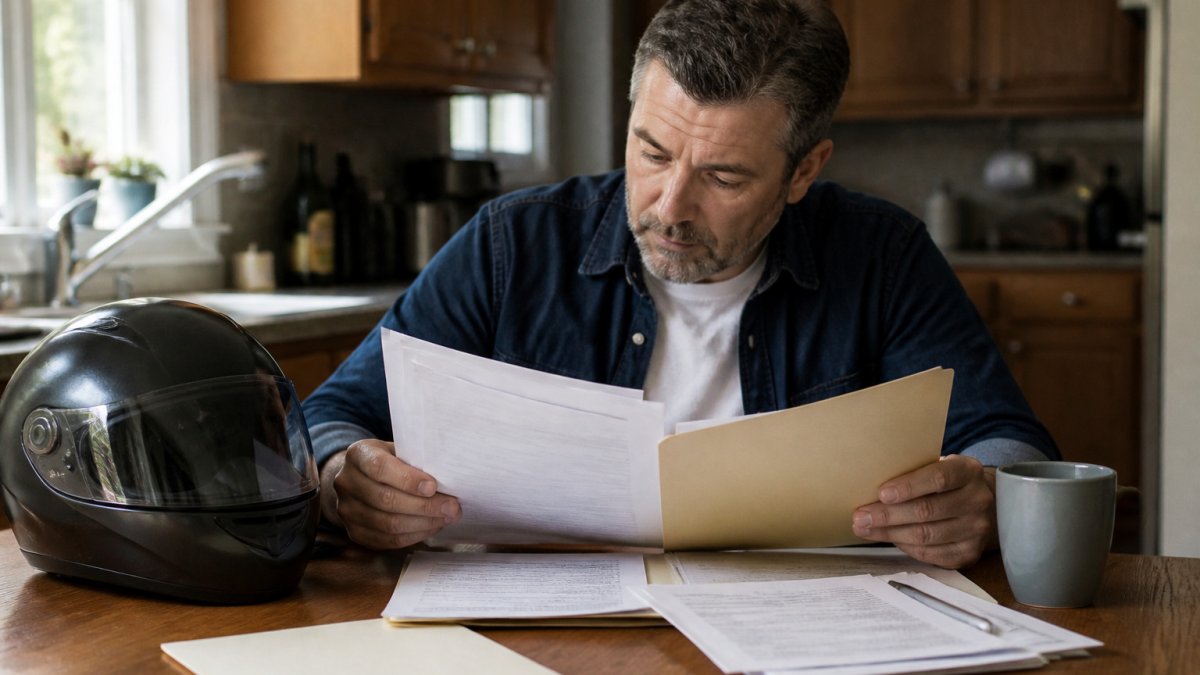
Once your documents are ready, apply with one or two lenders to compare offers. Then pick the one with the best total cost. If you are ready to look at bikes, you can browse our used motorcycle inventory to see what fits your budget.
Frequently Asked Questions
Can you finance a used motorcycle?
Yes. Many lenders, including credit unions, banks and dealerships, offer loans for used motorcycles. Approval depends on your credit history, income, debt levels and the bike itself, since older bikes, high mileage or a branded title can limit which lenders will finance them. Compare several offers before deciding, and confirm the exact rate and minimum with each lender.
Can you get a motorcycle loan from a dealership?
Yes. Many dealerships offer in-house or arranged financing through partner lenders. Dealer financing is convenient because you can apply and buy in one visit, but the rate may be higher than a credit union loan you arrange yourself. Get a preapproval from your own bank or credit union first, then ask the dealer whether it can beat that offer. This gives you a benchmark for comparing the two.
What credit score do you need to finance a used motorcycle?
There is no single minimum credit score that applies to every lender. Borrowers with good credit usually qualify for lower rates, while those with fair or poor credit may still be approved at higher rates or with a larger down payment. Some lenders also work with no credit history by considering income and employment. Check each lender's stated requirements and ask for the rate you would actually receive before applying.
Is it better to get a motorcycle loan from a bank or a dealer?
It depends on your credit and the offers available. Banks and credit unions often offer lower rates to qualified borrowers and are useful for private-party purchases, where a dealer loan is not an option. Dealers can be faster and may offer promotions, but compare the annual percentage rate, term and total cost of each offer before signing. A preapproval from your own lender gives you leverage when you talk with a dealer.
Financing a used motorcycle is easier when you know what lenders check and what the total cost will be. At CDM Truck And Cycle Sales, we help buyers in Clute and the surrounding area find a bike that fits their budget and their loan. Visit our showroom to talk through your options and find a bike that works for you.