 How-to
How to Calculate Heavy Duty Truck Fuel Efficiency
Last Updated: October 25, 2026
Quick Summary
To calculate truck fuel efficiency, divide miles driven by gallons used: a truck traveling 480 miles on 60 gallons gets 8.0 MPG. Use the fill-to-fill method, filling to the same click-off point twice and recording the odometer at both fills. Two or three fill cycles give a usable average, since one fill is noise.
- Federal rules define heavy-duty as vehicles with a gross vehicle weight rating of 8,501 pounds or greater.
- Add total miles and total gallons across fills, then divide once instead of averaging separate MPG figures.
- Convert MPG to liters per 100 kilometers with the formula 235.21 divided by MPG.
- Calculate fuel cost per mile by dividing price per gallon by MPG.
- Hold four factors constant and vary one, running each configuration for at least three fill cycles.
Table of Contents
- Step 1: Measure Fuel Used and Distance Traveled
- Step 2: Run the Truck Fuel Consumption Calculation
- Step 3: Convert MPG to Liters per 100 Kilometers and Other Units
- Step 4: Calculate Truck Fuel Cost per Mile
- Using a Truck Fuel Economy Calculator
- Factors Affecting Heavy-Duty Truck Fuel Efficiency
- Tracking Results to Verify Efficiency Improvements
- Finding a Used Truck That Delivers Strong Fuel Economy
- Frequently Asked Questions
Step 1: Measure Fuel Used and Distance Traveled
Learning how to calculate heavy duty truck fuel efficiency starts with two numbers: fuel burned and miles driven. Get them right and the rest is arithmetic; get them wrong and every cost estimate built on them is wrong too.
Federal rules define the heavy-duty category as vehicles with a gross vehicle weight rating of 8,501 pounds or greater, plus the engines that power them (Federal Register heavy-duty engine and vehicle rulemaking).
The Fill-to-Fill Method
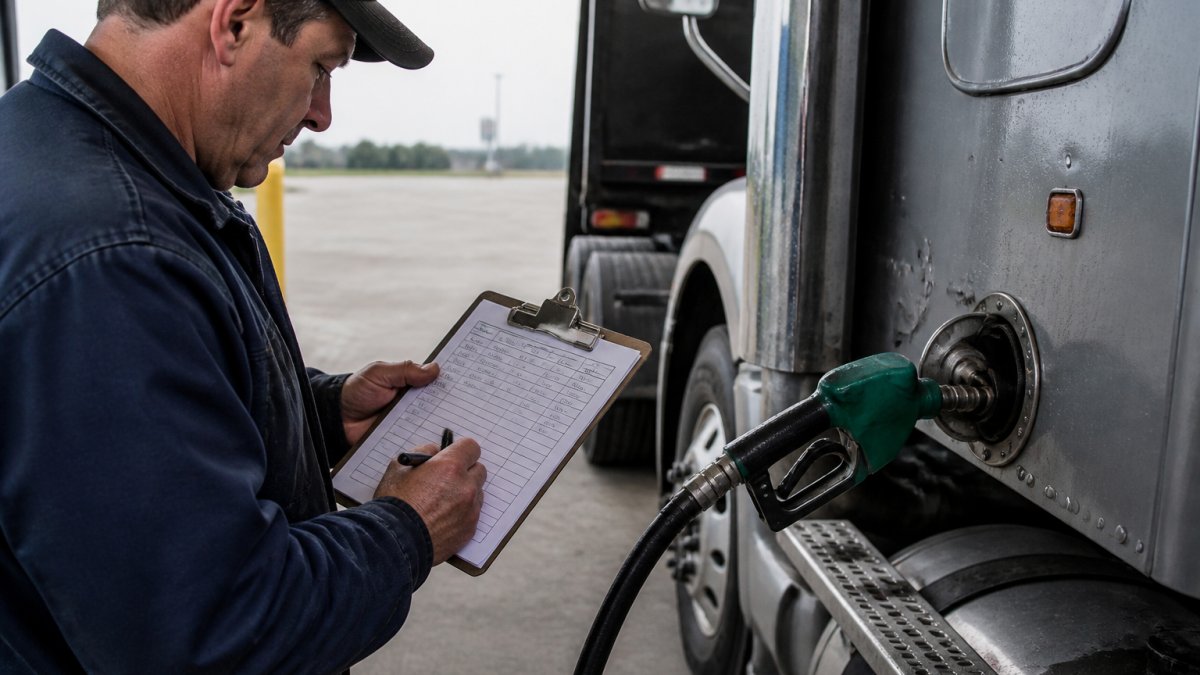
The fill-to-fill method is the simplest reliable way to measure truck fuel consumption: fill the tank to the same point twice, record the odometer at both fills, and divide miles driven by the gallons added at the second fill.
Here is a recommended protocol:
- Fill until the pump clicks off, then stop. Do not top off.
- Write down the odometer reading and the gallons on the receipt.
- Drive your normal routes until the tank is roughly a quarter full.
Two or three fill cycles give you a usable average. One fill is noise.
Telematics and Real-Time Measurement
Telematics gives you fuel data without a clipboard. Fleet tracking systems pull fuel rate and distance from the engine computer, yielding gallons burned per trip, per driver, and per route.
The tradeoff is data quality. A 2024 study reported LSTM-Conv model errors of 9.81% for fuel rate and 1.49% for trip fuel estimation (fuel consumption estimation in heavy-duty trucks). Model-based estimates are useful for spotting trends, but fill-to-fill remains the ground truth to check them against.
Step 2: Run the Truck Fuel Consumption Calculation
The truck fuel consumption calculation is short: miles driven ÷ gallons used = miles per gallon. A truck traveling 480 miles on 60 gallons gets 8.0 MPG. The work is in getting clean inputs and knowing which gallons to count.
Worked Example 1: Single Trip, Fill-to-Fill
- Odometer start: 142,310
- Odometer end: 142,790
- Miles driven: 480
This is the number most owner-operators quote, and the one most likely to be wrong: a single fill can be short by a gallon or two depending on nozzle position and starting tank level.
Worked Example 2: Three-Fill Average
| Fill | Miles Driven | Gallons Added | MPG |
|---|---|---|---|
| 1 | 460 | 58 | 7.9 |
| 2 | 505 | 60 | 8.4 |
| 3 | 475 | 61 | 7.8 |
| Total | 1,440 | 179 | 8.0 |
Add the miles, add the gallons, then divide once. Averaging three separate MPG figures weights a short fill the same as a long one, which skews the result.
Worked Example 3: Loaded vs. Unloaded Trip
A heavy-duty truck rarely runs the same weight both directions. Suppose a 400-mile outbound leg is loaded to 78,000 pounds GVW and burns 52 gallons, while the 400-mile return leg runs empty at 32,000 pounds GVW and burns 38 gallons.
- Loaded: 400 ÷ 52 = 7.7 MPG
- Empty: 400 ÷ 38 = 10.5 MPG
- Round trip: 800 ÷ 90 = 8.9 MPG
The round-trip figure matters for cost planning; the loaded figure matters for comparing trucks. Reporting only the round-trip average hides a 2.8 MPG spread a shipper or fleet manager needs to see.
Worked Example 4: Accounting for Idle Fuel
Idle hours burn fuel without adding miles, so a heavily idling truck shows worse MPG than the same truck on the same route with less idle time. If your telematics or ECM reports idle gallons separately, subtract them before dividing:
- Total gallons at refill: 60
- Idle gallons (from ECM): 6
- Driving gallons: 54
Report both numbers. The driving-only figure compares trucks fairly; the total figure reflects what you actually paid at the pump.
Worked Example 5: Partial Fill Correction
If you cannot fill to the same point every time, track cumulative gallons and miles across several fills and divide once at the end. The rule: never calculate MPG on a fill that did not top the tank to the same click-off point as the baseline fill.
Step 3: Convert MPG to Liters per 100 Kilometers and Other Units
Converting MPG to liters per 100 kilometers uses the formula 235.21 ÷ MPG = L/100 km. A truck at 8.0 MPG works out to 29.4 L/100 km.
Why bother with metric? Because fuel-consumption standards are often written in distance-specific units like liters per kilometer, or in distance-payload units (heavy-duty vehicle efficiency standards guide).
Common conversions:
- MPG to L/100 km: 235.21 ÷ MPG
- L/100 km to MPG: 235.21 ÷ L/100 km
- MPG to kilometers per gallon: MPG × 1.609
Watch out: L/100 km runs backward from MPG. A lower number is better.
Step 4: Calculate Truck Fuel Cost per Mile
To calculate truck fuel cost per mile, divide the price you paid for a gallon by your MPG. At $4.00 per gallon and 8.0 MPG, fuel costs $0.50 per mile.
The formula: price per gallon ÷ MPG = cost per mile.
Run it across a few MPG scenarios at the same fuel price:
| MPG | Fuel Price | Cost per Mile | Cost per 1,000 Miles |
|---|---|---|---|
| 6.5 | $4.00 | $0.62 | $615 |
| 7.5 | $4.00 | $0.53 | $533 |
| 8.5 | $4.00 | $0.47 | $471 |
The gap between 6.5 and 8.5 MPG is $144 per 1,000 miles. Over 80,000 miles a year, that is real money. This is the number to bring to a truck purchase decision, not the sticker price alone.
Using a Truck Fuel Economy Calculator
A truck fuel economy calculator does the division for you but cannot fix bad inputs. Enter odometer readings and gallons from your own fill-ups, not a spec sheet figure.
What a good calculator should handle:
- MPG from miles and gallons
- L/100 km conversion
- Cost per mile from a fuel price you supply
What it cannot do is separate a bad route from a bad truck. That takes the next section.
Factors Affecting Heavy-Duty Truck Fuel Efficiency
The factors affecting heavy-duty truck fuel efficiency fall into five buckets: the truck, the route, the driver, the weather, and the load. A single MPG number blends all five, so one trip's result is not a universal figure. The useful skill is holding four constant while you vary the fifth.
Driver behavior alone moves the needle. After a two-hour training course, study participants improved fuel economy by an average of 2.8%, according to North American Council for Freight Efficiency researchers (the role of truck drivers in sustainability).
Payload deserves its own line. Heavier loads burn more fuel per mile, and the ICCT notes standards can be written in distance-payload units precisely because payload changes the measurement.
A Normalization Framework: Hold Four, Vary One
To compare anything, run a baseline with four of the five factors held as constant as you can manage, then a test run where exactly one changes. The table below shows what to hold and what to record.
| Factor | What to hold constant | What to record |
|---|---|---|
| Truck | Same unit, same tire pressure, same trailer | Unit number, odometer, maintenance date |
| Route | Same roads, same direction, same stops | Route ID, elevation gain, stop count |
| Driver | Same driver, same shift length | Driver ID, hours driven |
| Weather | Same season, similar temperature and wind | Ambient temp, wind direction, precipitation |
| Load | Same payload and axle distribution | Scale ticket weight, trailer type |
Run each configuration for at least three fill cycles. One tank is not a comparison; it is an anecdote.
Isolating Each Factor in Practice
- Truck: compare two units on the same route, driver, load, and week. If not the same week, at least the same season so temperature does not confound the result.
- Route: same truck and driver, different roads. Note stop density and average speed; a 55 MPH highway run and a 35 MPH urban run are not the same test even at equal distance.
- Driver: same truck and route, swap drivers. Give each driver at least three fills; a new driver's first tank reflects unfamiliarity, not skill.
A 2019 study in Transportation Research Record calculated fuel economy per trip and as a function of average trip speed, which reflects how much trip-level conditions vary (impact of heavy-duty diesel truck activity on fuel). Speed and stop density belong in your notes for every run, not just the ones you suspect are outliers.
Metrics Beyond MPG
MPG is the default, but it is not always the right metric. Use the one that matches the decision:
- MPG: best for comparing trucks on similar routes and loads.
- Gallons per hour at idle: best for measuring idle cost, which MPG cannot capture because idle adds no miles.
- Gallons per ton-mile: best for comparing loads of different weights, and the unit many efficiency standards use.
Tracking Results to Verify Efficiency Improvements
Tracking turns a one-time calculation into a decision tool. Log every fill with date, odometer, gallons, route, load, and driver. After a month, you have a baseline. After a change, you have a comparison.
- Record odometer and gallons at every fill
- Note route type: highway, city, mixed
- Note approximate payload
Watch out: crediting an improvement to a new part or driving habit after one good tank is the most common tracking mistake. Seasonal temperature shifts alone move fuel economy, so give any change at least three fill cycles before you believe it.
Finding a Used Truck That Delivers Strong Fuel Economy
Spec sheets do not tell you what a used truck actually gets. Your own fill-to-fill logs do. That is why we tell buyers to ask for maintenance records and, where possible, fuel logs before they commit.
When you are ready to shop, our best trucks for heavy duty work guide breaks down which models suit which jobs. If you want to see current pricing before you set a budget, our used truck market trends report covers where the market sits. And when you are ready to see inventory in person, our pre-owned truck buying guide walks through the process from first look to keys.
A truck that fits your work and your budget beats a truck with a better brochure number every time.
Frequently Asked Questions
What is the fuel efficiency of a heavy-duty truck?
Heavy-duty trucks in the 8,501-pound GVWR class and above typically see fuel economy that varies widely with load, route, and driving conditions. A single trip result should not be treated as a universal figure. The best approach is to track your own truck's truck fuel efficiency over several fill-to-fill cycles so you have a baseline that reflects how you actually drive and haul.
How do you calculate a truck's miles per gallon?
Fill the tank to full, record the odometer, drive your normal route, then refill to full at the same pump. Divide the miles driven by the gallons added. For example, 450 miles divided by 50 gallons equals 9 MPG. Repeat over three to five tanks and average the results to smooth out fill-level variation and get a reliable truck fuel consumption calculation.
Does cruise control save fuel in a heavy-duty truck?
Cruise control can help on flat highway stretches by holding a steady speed and reducing throttle variation. On hilly routes it often hurts, because the system maintains speed uphill instead of letting momentum build. Test it on your own regular route and compare MPG across tanks before deciding whether it belongs in your fuel-saving routine.
What is a good fuel consumption rate for a heavy-duty truck?
There is no single good number, because payload and route change the result. A 2024 study of heavy-duty truck fuel consumption estimation reported model errors of 9.81% for fuel rate and 1.49% for trip fuel, which shows how much measurement method matters. Benchmark your truck against its own history and against similar trucks running similar loads rather than a generic figure.
Fuel math only pays off when the truck underneath it is sound. If you are shopping for a work truck and want straight answers instead of pressure, CDM Truck And Cycle Sales can help. We buy trade-ins even if you do not buy from us, we use our industry network to source specific vehicles, and we keep the process simple from first call to keys. Get started with CDM Truck And Cycle Sales and find a truck that earns its fuel bill.