 How-to
What to Check When Buying a Used Work Truck?
Last Updated: October 30, 2026
Quick Summary
Check the engine's cold start and fluids, the transmission and brakes, and the tires for uneven wear. Confirm payload and towing ratings from the truck's own door-jamb and hitch labels, not the brochure figure. Inspect the frame for structural rust and review maintenance records and title status before buying a used work truck.
- Write down your heaviest load, heaviest trailer, and yearly mileage before shopping.
- Calculate payload by subtracting curb weight from the GVWR on the door-jamb label.
- Frame rust that has eaten through metal is a serious structural problem; walk away.
- Run a vehicle history report by VIN and confirm the title matches the seller and the truck.
Table of Contents
- Start by Defining the Job the Truck Has to Do
- Verify Payload and Towing Capacity for the Actual Configuration
- Used Truck Inspection Checklist: Engine, Transmission, Brakes, and Tires
- Used Truck Frame Rust Inspection: Where Structural Damage Hides
- Reviewing Maintenance Records, Vehicle History, and Title Status
- Questions to Ask When Buying a Used Truck Before You Test Drive
- Booking a Used Truck Pre-Purchase Inspection Before You Buy
- Frequently Asked Questions
Buying a used work truck is a bigger commitment than buying a used car. A truck that looks solid on the lot can still hide a tired transmission, a rusted frame, or a towing rating that does not match the way you plan to use it. Buyers in the Clute area often ask the same questions: what should I check, and how do I avoid a costly surprise after the sale?
Start by Defining the Job the Truck Has to Do
Start by defining the work before you look at a single listing. The job determines the configuration you need: cab style, bed length, drivetrain, engine, and axle ratio.
Write down three things: the heaviest load you will carry, the heaviest trailer you will tow, and how many miles you expect to drive each year. Those three numbers narrow the field quickly.
Verify Payload and Towing Capacity for the Actual Configuration
Payload and towing ratings are not fixed numbers for a model name. They change with cab size, bed length, engine, axle ratio, drivetrain, and options, and the number that matters is the one for the exact truck on the lot. Most buyers stop at the brochure figure; the useful check is to work from the truck's own ratings labels and do the arithmetic for your actual load.
Read the ratings that are on the truck
- Door-jamb certification label. This lists the gross vehicle weight rating (GVWR) and the gross axle weight ratings (GAWR) for the front and rear axles for that specific vehicle. GVWR is the maximum the truck can weigh fully loaded, including passengers, fuel, cargo, and the tongue weight of a trailer.
- Tire and loading information label. This gives the maximum occupant and cargo weight for the truck as built. It is often lower than buyers expect once a heavy work body, toolbox, or crane is added.
- Trailer hitch label. The hitch itself has a maximum tongue weight and a maximum trailer weight, and those limits can be lower than the truck's advertised tow rating. A truck rated to tow 10,000 pounds may be capped by a hitch rated for less.
Do the payload math
Payload is GVWR minus the truck's curb weight. Curb weight is the truck with fluids and a full tank but no cargo or passengers. You can approximate it from a certified scale, or use the tire and loading label's cargo figure as a starting point. Then subtract everything you add:
- Driver and passengers
- Tools, shelving, and upfit equipment
- The tongue weight of any trailer you tow, which counts against payload
If the remaining number is smaller than the load you plan to carry, the truck is wrong for the job no matter what the brochure says.
Do the towing math
The gross combined weight rating (GCWR) covers the truck plus the loaded trailer. To check it, you need the truck's actual loaded weight and the trailer's loaded weight, not its empty weight. Compare the total to the GCWR, then confirm the trailer weight is within the hitch rating and the tongue weight is within the hitch and rear-axle limits. A truck that is already near its GVWR with tools and a work body has little capacity left for tongue weight.
Check the loaded vehicle weight before you commit
A common pattern is to buy the truck, load it for the first job, and discover it is over the rear axle rating.
Write the three numbers down before you shop: the heaviest load you will carry, the heaviest loaded trailer you will tow, and the tongue weight that trailer puts on the hitch. Then check every candidate truck against those numbers using its own labels, not the model's marketing figure.
Used Truck Inspection Checklist: Engine, Transmission, Brakes, and Tires
Work through the mechanical systems in a fixed order and write down a pass/fail for each item. A checklist you fill in as you go beats a mental walkaround, because it forces you to compare the same items across two or three trucks. Do not skip the cold start: ask the seller not to warm the engine before you arrive, then watch the first minute for smoke, odd noises, and warning lights that clear once the engine warms.
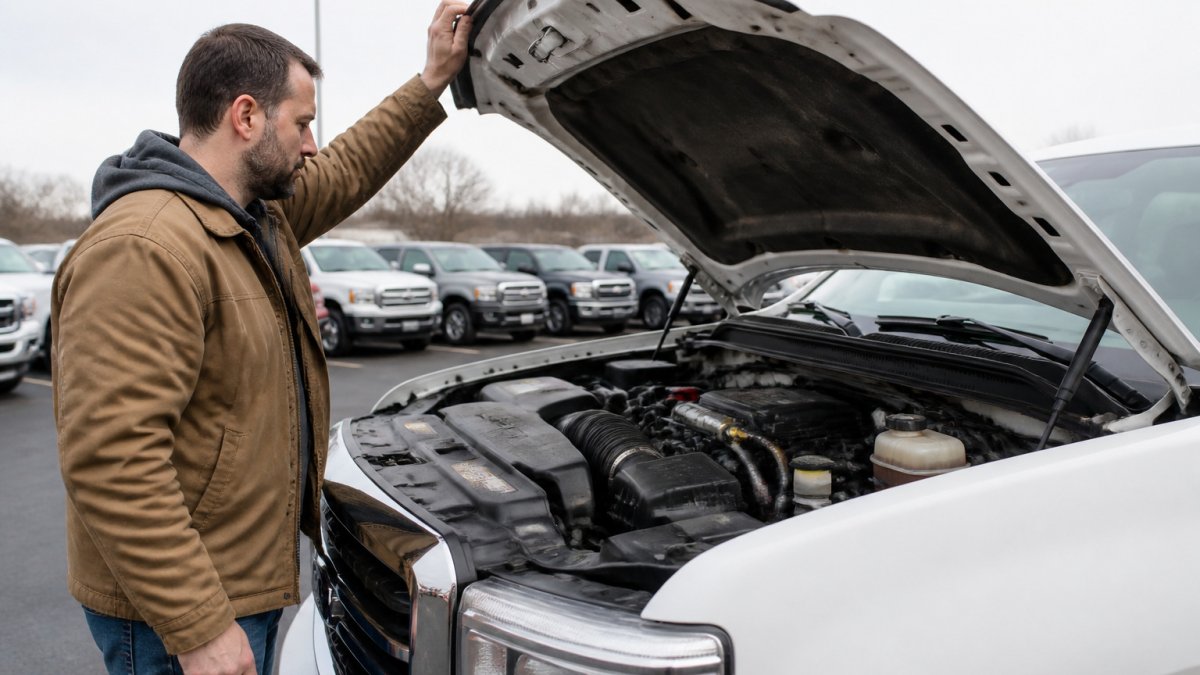
Engine and drivetrain
- Cold-start behavior. A puff of gray smoke that clears is common on higher-mileage engines. Blue smoke that persists points to oil burning; white smoke that does not dissipate can indicate coolant entering the combustion chamber. Either is a reason to slow down and get a compression or leak-down test.
- Fluids. Pull the oil dipstick: milky or frothy oil suggests coolant mixing, and gritty oil suggests deferred changes. Check coolant color and level, and look for crust around the water pump, hoses, and radiator tanks.
- Belts and hoses. Look for glazing, cracks, and soft spots. A serpentine belt is inexpensive; the collateral damage from a failed belt on a workday is not.
Brakes, tires, and suspension
- Brakes. Measure pad and rotor thickness if you can reach them; otherwise look through the wheel spokes for pad depth and rotor scoring. Feel for pulsing through the pedal and watch for the truck pulling to one side under braking. On a heavy-duty truck, confirm whether it has exhaust brakes or a tow/haul mode and test them.
- Tires. Check tread depth across the full width of each tire, not just the center. Uneven wear points to alignment, balance, or suspension problems. Matching brands, sizes, and load ranges across an axle are a good sign; mismatched tires on a work truck often signal a seller who fixed only what was needed to sell.
- Suspension and steering. Bounce each corner and listen for clunks. Look for leaking shock absorbers, cracked leaf springs, and worn shackle bushings. On a test drive, listen for front-end noise over bumps and check for play in the steering.
Work-body and upfit equipment
This is where a work truck differs from a pickup, and where a general checklist stops being useful. Inspect the equipment that does the job:
- PTO and hydraulics. If the truck runs a power take-off (PTO) for a dump bed, crane, or pump, cycle it through a full operation. Look for weeping hydraulic cylinders, cracked hoses, and contaminated fluid. Ask when the hydraulic filter was last changed.
- Liftgate. Raise and lower it fully loaded if you can. Check the motor, cables, and hinges for wear, and confirm the liftgate rating matches the loads you plan to move.
- Tool storage and shelving. Open every compartment. Look for water intrusion, rust at the mounting points, and whether the upfit was installed with proper reinforcement rather than self-tapping screws into sheet metal.
A quick look is not a full inspection. The pre-purchase inspection later in this guide is where a mechanic confirms what you found and catches what you missed.
The mechanical systems to check on a used work truck, the signs to look for, and what each one tells you.
| System | What to look for | Why it matters |
|---|---|---|
| Cold start | Gray smoke that clears; blue or persistent white smoke | Blue smoke can mean oil burning; persistent white smoke can mean coolant entering the chamber |
| Oil dipstick | Milky or frothy oil | Suggests coolant mixing into the oil |
| Transmission | Slipping, harsh engagement, delayed shifts, burnt smell | Signals internal wear or fluid problems |
| Brakes | Pulsing pedal, pulling to one side, scored rotors | Shows pad, rotor, or caliper wear |
| Tires | Uneven tread across the full width | Points to alignment, balance, or suspension problems |
| Frame | Flaking paint, soft spots, rust that has eaten through metal | Rust that has weakened metal is a serious structural problem |
Used Truck Frame Rust Inspection: Where Structural Damage Hides
Frame rust is one of the most expensive problems in a used truck, and it often hides behind fresh paint or undercoating. Get the truck on a lift, or at least lie on the ground with a flashlight, and check the frame rails, crossmembers, and the areas around the spring hangers and shackles.
Look for flaking, bubbling paint, and soft spots you can poke with a screwdriver. Check where the bed mounts to the frame and around the rear axle.
Reviewing Maintenance Records, Vehicle History, and Title Status
Paperwork shows you what the truck has been through. Ask for maintenance records first. Regular oil changes, transmission service, and brake work are good signs. Large gaps in service history are not automatically a deal-breaker, but they mean you need a more thorough inspection.
Run a vehicle history report using the VIN. Look for previous owners, accident history, odometer discrepancies, and title status. A title marked salvage, rebuilt, or flood damage affects insurance, resale value, and financing.
Questions to Ask When Buying a Used Truck Before You Test Drive
Good questions save time and reveal how the seller operates. Ask how long they have owned the truck and why they are selling it. Ask whether it has ever been used for towing and what it pulled.
Ask directly about warranty coverage and whether any warranty remains on major components. Ask whether the truck has been in an accident, even a minor one.
Booking a Used Truck Pre-Purchase Inspection Before You Buy
The most useful step in this process is a pre-purchase inspection by a trusted mechanic who is not connected to the seller.
Ask the mechanic to focus on the systems most relevant to your planned work: the drivetrain for towing, the suspension for heavy loads, and the frame for structural integrity.
When you are ready to compare trucks, you can browse current options and find the right fit for your work through search all vehicles on the CDM Truck And Cycle Sales site.
Frequently Asked Questions
What should you look for in a used work truck's maintenance records?
Look for regular oil changes, transmission and differential service, coolant flushes, brake work, and tire rotations logged at the intervals in the owner's manual. Records from a dealer or established shop carry more weight than handwritten notes with no receipts. Gaps in service history on a truck used for heavy hauling are a warning sign, especially if the odometer shows high mileage. Ask the seller directly what work the truck did and who maintained it, then compare their answers with the paperwork.
Should you get a used work truck inspected by a mechanic before buying?
Yes. A pre-purchase inspection by an independent mechanic you choose, not one the seller recommends, is the most reliable way to catch problems you cannot see on a test drive. The mechanic can check frame rust, leaks, suspension wear, and engine and transmission condition, and can scan for stored fault codes. Ask for a written report. The cost is usually modest compared with the repair bills it can prevent, and a seller who refuses the inspection is a reason to walk away.
How do you know if a used work truck is right for your job?
Start with the heaviest load and longest towing trip you expect. Check the gross vehicle weight rating, payload capacity, and gross combined weight rating on the door sticker, since these numbers change with cab, bed, axle, and engine configuration. A truck that handles light hauling can be overloaded quickly on a job site. Match the drivetrain, bed length, and engine to daily use, and confirm the truck has the equipment you need, such as a trailer brake controller or a hitch rated for your trailer.
What questions should you ask before buying a used work truck?
Ask how the truck was used, whether it has been towing or hauling heavy loads, and whether it has ever been in an accident. Ask for the vehicle history report and confirm the title status is clean, not salvage or rebuilt. Ask when the last major services were done, whether the timing belt or chain has been replaced, and why the owner is selling. Ask whether there are open recalls and whether the truck is still under warranty. Honest, specific answers are a good sign.
Ready to find a truck built for your work? Visit CDM Truck And Cycle Sales in Clute to see our inventory, and we will help you match the right configuration to the job.