 How-to
5 Used Truck Warranty Options Explained for Buyers
Quick Summary
A used truck warranty is a promise to pay for certain repairs after the sale, and it can come from the manufacturer, a certified pre-owned program, a dealer, or a third-party company. Coverage levels range from powertrain only to nearly bumper-to-bumper, but exclusions decide what you actually get paid for. Read the full contract before you buy.
- Check remaining factory warranty time and mileage limits first, since both can end coverage.
- Certified pre-owned programs usually include an inspection and coverage beyond the factory warranty.
- Ask whether a plan covers labor, diagnostic time, and seals, not just the part itself.
- Confirm the per-claim cap and deductible structure before you rely on a plan for a major repair.
- Trucks past 100,000 miles often face higher risk, so check whether a provider accepts them.
Table of Contents
- Why Warranty Options Matter When Buying a Used Truck
- Step 1: Check the Remaining Factory Warranty
- Step 2: Compare Certified Pre-Owned and Third-Party Plans
- Step 3: Review Used Truck Warranty Coverage and Exclusions
- Step 4: Estimate Used Truck Warranty Cost Against Ownership Costs
- Step 5: Look at Extended Warranty Options for Used Trucks Over 100,000 Miles
- Buying an Extended Warranty After You Purchase a Used Truck
- Your Next Step: Bring Your Shortlist and Records to Our Showroom
- Frequently Asked Questions
Why Warranty Options Matter When Buying a Used Truck
Last Updated: November 3, 2026
A used truck can look like a bargain until the first major repair bill arrives. That is why understanding used truck warranty options matters before you sign anything.
A used truck warranty is a promise to pay for certain repairs after the sale.
Warranty options matter for three simple reasons:
- They limit surprise costs. A single transmission repair can cost thousands of dollars.
- They show what the seller stands behind. Coverage length and terms reveal how confident the seller is in the truck.
- They shape your total cost. A cheaper truck with no coverage can cost more over time than a pricier one with solid protection.
Many buyers focus only on the sticker price. A common mistake is skipping the warranty review because the monthly payment looks manageable. Read the contract before you commit.
Step 1: Check the Remaining Factory Warranty
Start by finding out whether the truck still has manufacturer coverage. Many newer used trucks carry some factory warranty time left.
Ask the seller for the truck's VIN and check the remaining coverage with the manufacturer.
Look for these details:
- Time remaining: Coverage is often listed in months.
- Mileage limit: Coverage ends at a set number of miles, even if time remains.
- Covered parts: Basic warranties and powertrain warranties cover different systems.
Watch out: A truck may have time left on its warranty but few miles left in the mileage cap. Check both limits before assuming you are protected.
Step 2: Compare Certified Pre-Owned and Third-Party Plans
Certified pre-owned (CPO) programs are backed by the manufacturer or a dealer. They usually include a vehicle inspection, a set warranty period, and extra coverage beyond the factory warranty.
Third-party extended warranties are sold by independent companies. Their quality varies widely. Some are solid. Others have strict claim rules and limited repair shop choices.
When comparing the two, ask:
- Who backs the warranty if the company goes out of business?
- Which repair shops can I use?
- Does the coverage start immediately?
Compare at least two options before choosing. Do not accept the first plan offered without questions. Our buyer's guide to pre-owned trucks in Clute explains how dealer-backed options work when shopping for a pre-owned truck.
Step 3: Review Used Truck Warranty Coverage and Exclusions
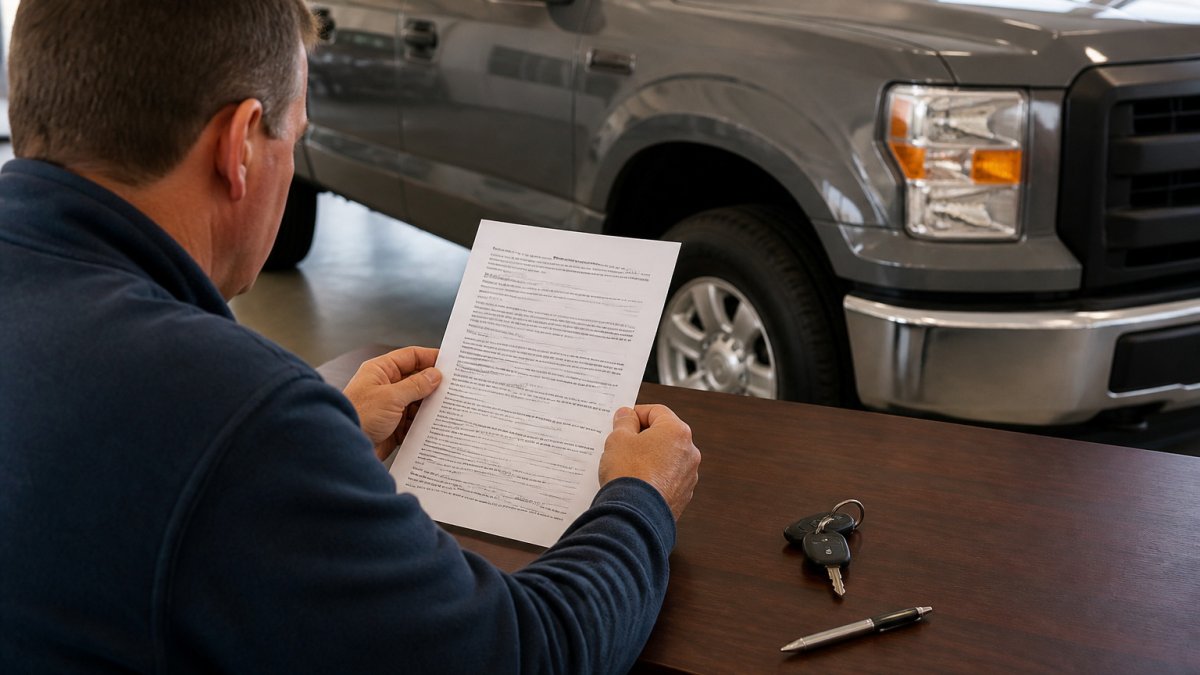
This step matters most. Coverage sounds good on paper, but exclusions decide what you actually get paid for. Read the full contract, not just the sales brochure. The goal here is not to memorize warranty categories, it is to verify one specific contract before you sign it.
Most used truck warranty plans fall into a few common levels:
- Powertrain only: Covers the engine, transmission, and drive parts.
- Limited: Covers major systems such as steering, brakes, and electrical parts, with exclusions.
- Exclusionary (bumper-to-bumper): Covers nearly everything except a short list of excluded parts.
Typical exclusions include:
- Wear items like brake pads, tires, wiper blades, and filters
- Damage from accidents, misuse, or lack of maintenance
- Pre-existing problems that were not disclosed
A common mistake is assuming "bumper-to-bumper" means everything is covered. It rarely does. Ask for the exact list of excluded parts in writing.
How to Verify a Specific Contract Before You Sign
Use this sequence on the actual contract document, not a summary sheet:
- Find the covered-components list. For a powertrain plan, confirm the contract names the engine, transmission, transfer case, drive axles, and differentials individually. If a component is not named, assume it is not covered.
- Read the exclusions section line by line. Look specifically for seals and gaskets, diagnostic fees, shop supplies, and fluid charges. Many plans cover the part but not the labor to diagnose it.
- Confirm the deductible structure. Is it per visit or per component? Is it waived if you return to the selling dealer? A per-component deductible can multiply across a single repair.
- Check repair authorization rules. Most contracts require you to call the administrator for approval before any work begins. Confirm the phone number, the hours, and whether after-hours breakdowns have a separate process.
- Verify the repair network. Ask whether you can use any licensed shop or only a network. If you rely on an independent diesel shop, confirm it is eligible before you buy.
- Look at claim limits and caps. Find the per-claim maximum and the total aggregate limit. A plan with a low per-claim cap may not cover a major engine or aftertreatment repair.
- Read the cancellation and transfer terms. Confirm the cancellation window, any restocking fee, and whether the plan transfers to a private buyer if you sell the truck.
Watch out: A plan that covers the component but excludes the labor, diagnostic time, or related seals can still leave you with a large out-of-pocket bill on a single repair.
Also check the claim process in practice. Some plans require you to get repair authorization before work starts. Skipping that step can void your claim.
The common warranty levels and typical exclusions are summarized below.
| Coverage level | What it covers | Watch for |
|---|---|---|
| Powertrain only | Engine, transmission, drive parts | Major systems outside the powertrain are not included |
| Limited | Major systems such as steering, brakes, electrical parts | Exclusions apply to listed parts |
| Exclusionary (bumper-to-bumper) | Nearly everything except listed exclusions | Rarely covers everything; get the exclusion list in writing |
| Wear items | Brake pads, tires, wiper blades, filters | Usually excluded |
| Accident or misuse damage | Not covered | Lack of maintenance can void coverage |
| Undisclosed pre-existing problems | Not covered | Disclose known issues before buying |
Step 4: Estimate Used Truck Warranty Cost Against Ownership Costs
Warranty cost should be measured against what you might actually spend to own the truck. Pricing for used truck warranty plans depends on the truck's age, mileage, make, model, and the coverage level you choose.
To judge whether a plan is worth it, compare:
- The plan price against your likely repair exposure
- The deductible against the typical repair bill you would face
- The coverage length against how long you plan to keep the truck
For example, a plan that costs more than you would spend on likely repairs may not be worth it. A plan that covers a costly engine or transmission failure may be worth the price for a high-mileage truck.
A Truck-Specific Value Framework
General used-car advice stops at "compare the premium to repair costs." For a truck, the math has to account for how the truck is used, because that drives both failure risk and downtime cost.
Start by writing down four inputs:
- Truck age and mileage. A truck past 100,000 miles is entering the window where wear items and major components overlap. A truck under 50,000 miles with remaining factory coverage has less exposure.
- Usage pattern. A truck that tows or hauls daily puts more stress on the transmission, cooling system, and brakes than a truck used for light errands. Heavy use raises the odds that a powertrain claim is needed.
- Your ability to pay for an unexpected repair. If a major repair would strain your budget, a plan that caps that exposure has value even if the expected payout is lower than the premium.
- Downtime cost. If the truck is your work vehicle, a week in the shop has a cost beyond the repair bill. Confirm whether the plan includes towing or rental reimbursement, and read the daily and total caps on those benefits.
Component Cost Anchors
You do not need exact quotes to compare, but you should know which repairs drive the decision. On a used truck, the repairs that most often justify a plan are:
- Engine and aftertreatment work. Diesel emissions components, turbochargers, and injectors are among the costliest common failures on late-model trucks.
- Transmission and driveline. A rebuild or replacement can exceed the price of many plans on its own.
- Differentials and transfer cases. These are frequently excluded from limited plans and expensive to repair.
Ask the administrator which of these components are named in the contract and what the per-claim cap is. A plan that names the engine but caps the claim below a typical rebuild cost is not real protection for that failure.
Comparing the Premium to Exposure
A practical way to decide is to compare the plan price to the cost of the one or two repairs most likely for your truck. If the premium is close to the cost of a single major repair and the contract clearly covers that repair, the plan is easier to justify. If the premium is high and the contract excludes the components you are most worried about, the plan is not solving your problem.
Ask whether payment can be spread out or added to your loan. Some buyers add the cost to their financing. Make sure you understand how that affects your total payment, and confirm the plan price is disclosed separately from the vehicle price so you can compare it on its own.
Step 5: Look at Extended Warranty Options for Used Trucks Over 100,000 Miles
Trucks with more than 100,000 miles carry more risk. Wear builds up over time, and repairs can come quickly. Extended warranty options for these trucks often cost more, and some providers limit coverage or refuse older vehicles altogether.
If you are looking at a high-mileage truck, check these points:
- Does the provider accept trucks at this mileage?
- Is the coverage limited to powertrain only?
- Are there age or mileage caps for future claims?
Heavy-duty and commercial trucks often face higher repair costs. Confirm that the plan covers the components you rely on most, such as the diesel engine, transmission, and differentials.
Buying an Extended Warranty After You Purchase a Used Truck
You can often buy an extended warranty after the sale, but timing matters. Some providers only sell plans within a set window after purchase. Others limit coverage if the truck already has problems.
Before you buy after the fact, confirm:
- The provider's deadline for new contracts
- Whether a pre-purchase inspection or mileage check is required
- Whether any existing issues will be excluded
Buying a plan early is usually simpler. If you wait, a problem that already exists may be excluded, and the price may increase.
Your Next Step: Bring Your Shortlist and Records to Our Showroom
Now you know the main used truck warranty options and what to check before you buy. Bring your shortlist of trucks, any maintenance records, and questions about coverage to our showroom in Clute. We also buy trade-ins even if you do not buy from us.
Search All Vehicles on our site to see what is available now.
Frequently Asked Questions
Which used truck warranty offers the best coverage?
No single plan is best for every truck. Manufacturer-backed certified pre-owned coverage usually includes the broadest protection and the most reliable repair network, while third-party plans vary widely in what they cover. Compare the powertrain terms, the list of covered components, the deductible, and whether you can use any licensed repair facility. Read the exclusions section carefully before you sign, because that is where coverage gaps usually appear.
Is it worth buying a warranty on a used truck?
It depends on the truck's age, mileage, and your tolerance for unexpected repair bills. A warranty can protect you from a major powertrain failure, which can cost thousands of dollars to fix. Weigh the plan's price against the repairs you would likely face on that specific truck. If the truck has a clean maintenance history and a recent pre-purchase inspection, you may decide the coverage is not worth the cost.
What does an extended warranty for a used truck typically cover?
Most extended warranties cover the engine, transmission, and drivetrain components, and some offer broader bumper-to-bumper coverage. Common exclusions include wear-and-wear items such as brakes, tires, and clutches, along with pre-existing damage and routine maintenance. Always ask for the contract in writing and confirm which components are listed as covered before you buy.
Can you buy an extended warranty for a used truck after purchase?
In many cases, yes. Some providers sell service contracts after the sale, but availability, mileage limits, and pricing differ by plan. Buying a warranty later may cost more, and some plans require a recent inspection before coverage starts. Ask the provider about waiting periods and any inspection requirements so you know the coverage start date before you commit.