 How-to
How Do You Check a Motorcycle Title Status?
Last Updated: November 7, 2026
Quick Summary
To check a motorcycle title status, first gather the full 17-character VIN from the frame and compare it to the title paperwork. Then run a free VINCheck, search the issuing state's motor vehicle agency, and order an NMVTIS report, since motorcycle title status can show liens, salvage or rebuilt brands before you buy.
- Gather the full 17-character VIN from the frame and match it to the title paperwork.
- VINCheck is a free first screen for stolen or total-loss reports, but it is not a complete history.
- Run the state motor vehicle agency lookup and an NMVTIS report, then reconcile the two records.
- Require a lien release letter from the lienholder if the title shows an open lien.
- A no-record result is not proof of a clean title; re-check the VIN and call the agency.
Table of Contents
- What a Motorcycle Title Status Check Tells You
- Gather the Information You Need Before You Search
- Run a Free Title Check by VIN
- Check the State DMV Title Record and NMVTIS Title Check
- Confirm Liens and Salvage or Rebuilt Brands
- Motorcycle Salvage Title Check: Reading Branded Results
- Booking Your Next Step at CDM Truck And Cycle Sales
- Frequently Asked Questions
What a Motorcycle Title Status Check Tells You
A motorcycle title status check shows whether a title record exists, what state issued it, and whether the bike carries a lien or a branded title such as salvage or rebuilt. Before you hand over any money, you should know that answer. Running this check on every bike you consider, including ones you find through private sellers, is a sound habit.
Title status is not the same as a full vehicle history. A title check focuses on ownership and legal standing. It can flag a salvage brand or an open lien, but it may not show every repair, crash, or past owner. Think of it as the first gate, not the only one.
A title check can answer four core questions:
- Does the title exist? A missing or unreadable record is a warning sign.
- Who holds it? The registered owner should match the person selling the bike.
- Is there a lien? An open lien means a lender may still have a legal claim.
- Is it branded? Salvage, rebuilt, or flood brands change the bike's value and insurance options.
Watch out: A clean result on one database does not guarantee a clean title. Motorcycles are often missing from databases built around cars, so run more than one check.
Gather the Information You Need Before You Search
You need the vehicle identification number, or VIN, before you can run a title status search. The VIN is a 17-character code on most motorcycles, usually stamped on the steering head or frame. Compare it against the number on the title paperwork. If they do not match, stop and ask questions.
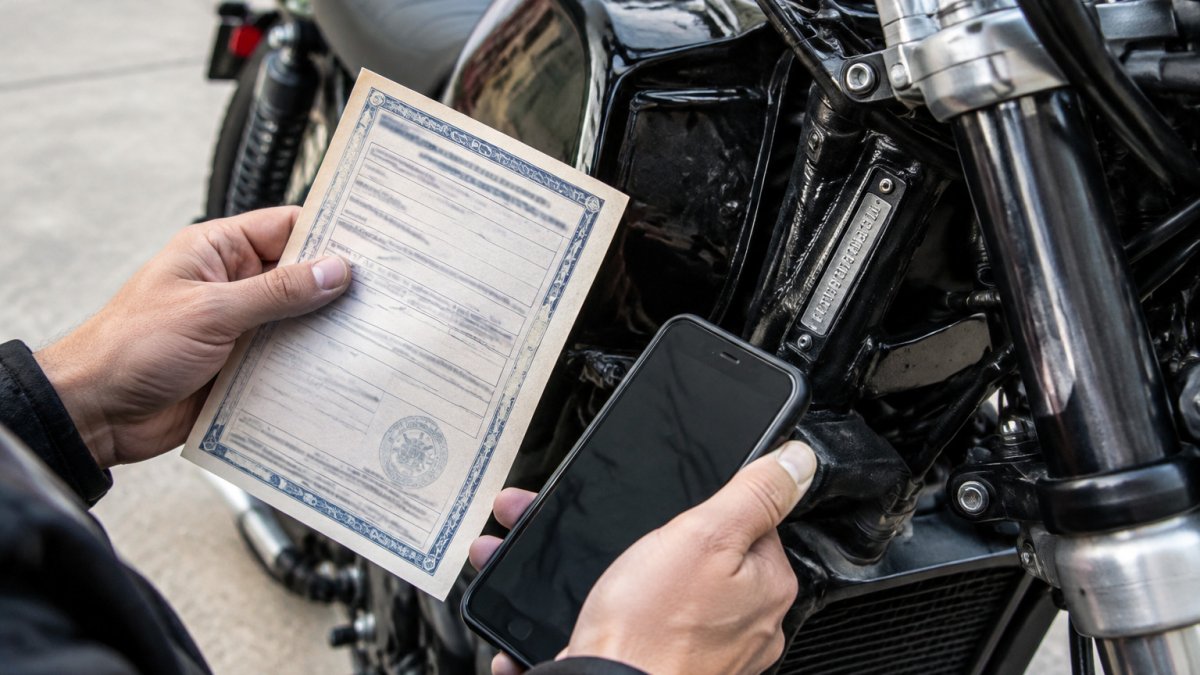
Collect these items before you start:
- The full VIN from the bike, not just the paperwork
- The state where the title was issued, if you know it
- The seller's name and the name printed on the title
- The current odometer reading, if the seller provides it
- Any lien or lienholder information the seller discloses
A photo of the title and the VIN plate makes the comparison easier. Keep the seller's answers in writing, since a short email or text can help if a dispute comes up later.
Run a Free Title Check by VIN
A free title check by VIN is the quickest first step for most buyers. The National Insurance Crime Bureau runs VINCheck, which lets you check whether a vehicle has been reported stolen or declared a total loss by participating insurers. It covers some motorcycles, but it does not cover every bike or provide a complete history.
Use VINCheck for a quick stolen and total-loss screen, then move to the more detailed checks below. A negative result is useful, but it is not proof that the title is clean.
Check the State DMV Title Record and NMVTIS Title Check
A nationwide title check is really two lookups run in sequence: the state motor vehicle agency that issued the title, then the National Motor Vehicle Title Information System (NMVTIS). Most practitioners run the state record first because it is the source of truth for the current title, then use NMVTIS to catch brands and title activity from other states.
Step 1: Identify the issuing state. Ask the seller which state titled the bike and in what year.
Step 2: Search the state motor vehicle agency. Most state DMVs and motor vehicle divisions offer an online title-status or VIN lookup, though the fields exposed vary widely.
Step 3: Run an NMVTIS report. The U.S. Department of Justice oversees NMVTIS, and the system aggregates title, brand, and total-loss data reported by states and insurers (National Motor Vehicle Title Information System (NMVTIS) | Overview).
Step 4: Reconcile the two records. Compare the title state, title number, issue date, lien status, and brand on both results. A common pattern is a state record that shows a clean title while NMVTIS shows a salvage brand from a prior state, that usually means the bike was retitled after repair and the brand did not carry forward in the state's online display. Treat any disagreement as unresolved until the seller and the state explain it in writing.
Step 5: Confirm with the agency when online records fall short. If the online lookup returns nothing, call the state motor vehicle agency's title division.
Watch out: A no-record result is not proof of a clean title.
The article lays out a sequence of checks, and the table below summarises each step, what it confirms and what to watch for. For a full physical inspection checklist to confirm the bike's condition matches its paperwork, see how to inspect a used motorcycle.
| Step | What to do | Watch for |
|---|---|---|
| 1. Identify issuing state | Ask the seller which state titled the bike and when | Bike may carry a title from a state the seller never mentions |
| 2. Search state agency | Run the DMV or motor vehicle division VIN lookup | Some states charge a few dollars for a title record |
| 3. Run NMVTIS report | Use an approved provider for a report | Typically costs a few dollars |
| 4. Reconcile records | Compare title state, number, date, lien and brand | Disagreement means unresolved until explained in writing |
| 5. Confirm with agency | Call the title division if online records fall short | Recent transactions may not have posted online yet |
Confirm Liens and Salvage or Rebuilt Brands
A lien means a lender still has a legal claim on the bike. If you buy a motorcycle with an open lien, the debt can stay attached to the bike, and the lender may have the right to repossess it. Ask the seller for a lien release letter from the lienholder, and confirm the release with the state record.
Branded titles matter just as much. A salvage title means an insurer declared the bike a total loss. A rebuilt title means a salvage bike was repaired and passed a state inspection. Rebuilt bikes can be safe, but they often sell for less and may be harder to insure. Only you can decide whether that tradeoff works for your budget.
Watch out: Some sellers remove or ignore a brand. Always check the brand on the state record, not just the paper title the seller hands you.
Motorcycle Salvage Title Check: Reading Branded Results
A motorcycle title check returns more than a clean-or-dirty answer. Each status should prompt a specific next step, and motorcycle records differ from car records in ways that change how you read the result.
How motorcycle records differ. Motorcycles are often titled and registered in smaller volumes than cars, and some states process motorcycle titles through the same system while others handle them separately. VINs on motorcycles are commonly 17 characters, but older or off-road bikes may carry shorter VINs that some databases cannot match.
What each status means and what to do next:
- Clean title: No brand or lien appears on the records you checked. Next step: confirm the VIN on the frame matches the VIN on the title and on the report, then proceed to a physical inspection.
- Lien recorded: A lender holds a legal claim. Next step: require a lien release letter from the lienholder and confirm the release with the state record before any money changes hands. An open lien can follow the bike, and the lender may have the right to repossess.
- Salvage brand: An insurer declared the bike a total loss at some point. Next step: get a full mechanical and frame inspection, and confirm whether your state allows a salvage bike to be retitled for road use. Insurance and resale value are both affected.
- Rebuilt brand: A salvage bike was repaired and passed a state inspection. Next step: ask for repair receipts and the inspection record, and confirm the rebuilt brand appears on the current title, not just an older record.
- Flood or other brand: The bike was damaged by water or another event a state chose to disclose. Next step: have a mechanic check for corrosion and electrical damage, since flood damage often surfaces months later.
- Pending or undeliverable title: The title has been applied for but not issued, or was mailed and not delivered. Next step: ask the seller for the application receipt or a duplicate-title request, and confirm with the state agency that a title is in process.
- No record found: The VIN may be mistyped, the bike may be titled in another state, the transaction may be too recent to post, or the bike may never have been titled. Next step: re-enter the VIN, widen the search to other states, and ask the seller for a copy of the title.
- Conflicting results: Two databases disagree. Next step: treat the bike as unresolved until the seller and the state agency explain the discrepancy in writing.
When the paper title and the online record disagree. A common pattern is a paper title that looks clean while the state or NMVTIS record shows a brand or lien. The online record generally reflects what the state has on file, so a mismatch is a reason to pause, not to pick the more convenient answer.
Watch out: Sellers sometimes present a clean paper title from an earlier state while the current state record carries a brand. Always compare the brand on the state record against the paper title, and treat the state record as the controlling version until the agency confirms otherwise.
Booking Your Next Step at CDM Truck And Cycle Sales
Once you know the title is clean, the next step is a physical inspection of the vehicle. Visit our Clute, Texas showroom to discover how we prioritize your needs and simplify the car buying journey.
Frequently Asked Questions
Can you look up a motorcycle title number online?
Some states let you check title status online through the state DMV or motor vehicle agency, but the lookup usually requires the VIN and sometimes the title number or owner details. Availability varies by state, so start with your state's official motor vehicle website. If the state does not offer an online status inquiry, you will need to contact the motor vehicle agency directly or request the record in person or by mail. Always confirm you are on an official government site before entering any personal information.
Can a VIN show a motorcycle's title status?
A VIN alone can reveal useful information, such as whether a record exists in a national database and whether a title brand or theft report has been filed. The National Insurance Crime Bureau's VINCheck tool can flag some insurance total-loss records, and NMVTIS provides title and brand history for many vehicles. However, a VIN check does not guarantee a complete history. Results depend on the information reported, so pair the VIN search with a state DMV record review before buying.
How can I tell if a motorcycle title is salvage or rebuilt?
Look for a brand printed on the title itself or listed in the history record. A salvage brand generally means the motorcycle was declared a total loss by an insurer or otherwise damaged to the point of being branded. A rebuilt brand means it was repaired and later passed a state inspection to return to the road. Ask the seller for the physical title, compare the brand against the state record, and check the status with the DMV before paying. Brand rules and labels vary by state.
What should I do if the seller's name does not match the motorcycle title?
Do not complete the purchase until the names match. The registered owner on the title should be the person selling the motorcycle, or the seller must show a properly signed transfer and any required documentation. A mismatch can signal a lien, an unreleased prior owner, or a stolen or fraudulent sale. Contact your state DMV to confirm the ownership record, and consider a bill of sale that lists the VIN, price, and date. If the seller cannot clear the discrepancy, walk away.